The Best Whole House Water Filters for Well Water
Well water brings sediment, iron, sulfur, and hardness that city water never does. Here is how to match a whole house system to your own water chemistry.
 By Ethan Walker
Updated November 5, 2026
Well water is a different animal from municipal water. Nobody treats it before it reaches your pressure tank, nobody checks it on a schedule, and nobody is responsible for what comes out of the tap except you.
Depending on the aquifer, that can mean grit that clogs aerators, dissolved iron that stains fixtures orange, manganese that dulls laundry, sulfur that makes the house smell like rotten eggs, and hardness that quietly wears out a water heater.
A pitcher or an under-sink cartridge cannot move enough volume to solve any of that, which is why the best whole house water filters for well water are sized around the plumbing, not around a single faucet.
This guide is built from research rather than guesswork.
We compare specifications, published performance data, expert review consensus, and verified buyer feedback, then score every system on a consistent 0 to 10 APT Score so the picks reflect real ownership instead of a spec sheet.
Sediment and iron rarely travel alone, and hard water usually arrives with them, so plenty of households pair filtration with a softener. That pairing is covered in our look at whole-house filtration and softener systems.
Below are the three systems that hold up best across the widest range of well water problems.
The 3 Best Whole House Water Filters for Well Water on Our Shortlist (November 2026)

- Best for: Sediment, chlorine and taste
- Stages: 3
- Type: Whole house
- Brand: iSpring

- Best for: Multi-stage and UV treatment
- Type: Whole-house tank system
- Treatment: Filtration plus UV
- Brand: Aquasana
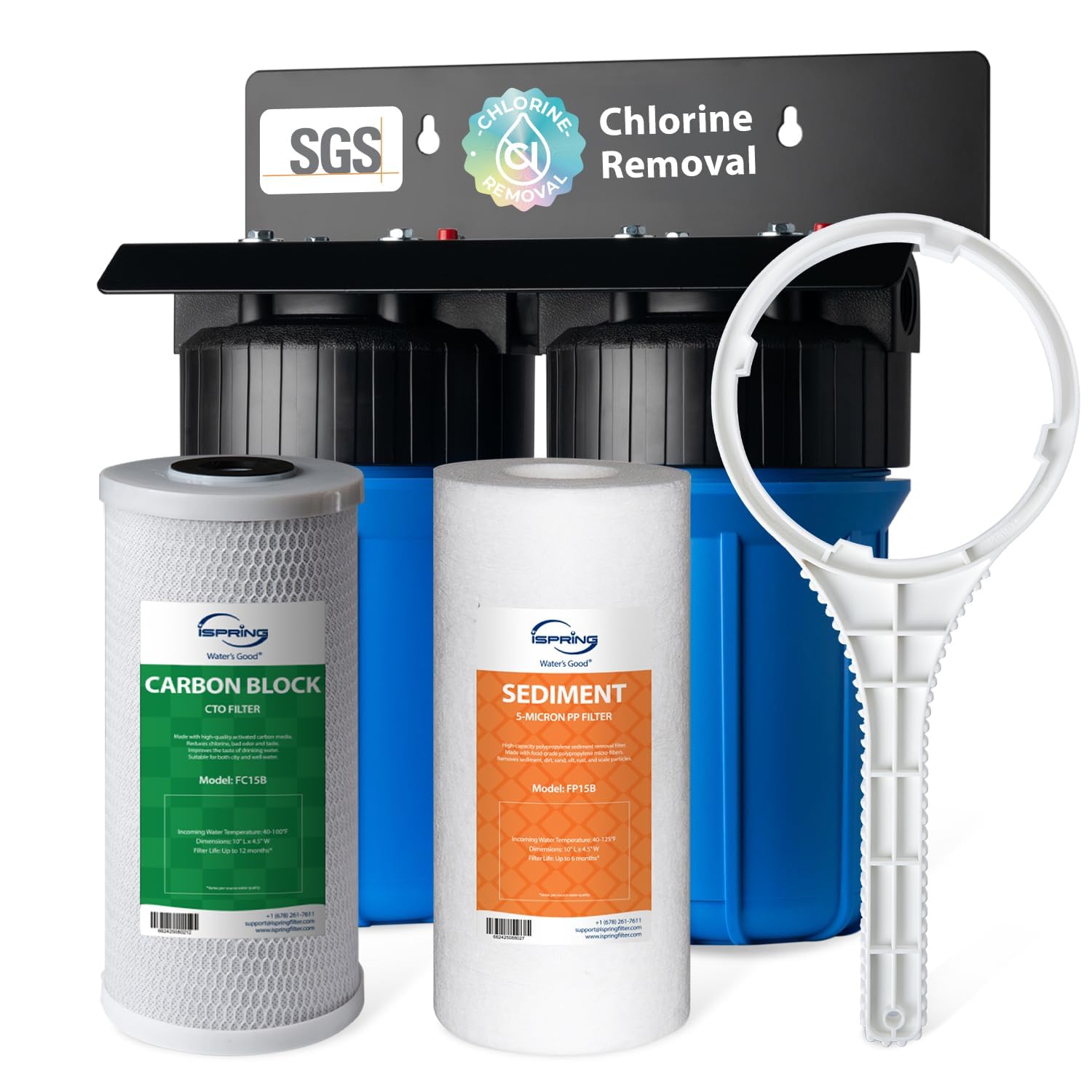
- Best for: Budget whole-house filtering
- Stages: 2
- Addresses: Sediment, chlorine, VOCs
- Brand: iSpring
This post may contain affiliate links. As an Amazon Associate we earn from qualifying purchases.
| Award | Product | APT Score About LAT ScoreThe APT Score is our own rating from 0 to 10, based on performance, design and build, ease of use, and value. It reflects independent research and is never influenced by manufacturers, retailers, or affiliate commissions. Learn more › | Price | |
|---|---|---|---|---|
| Best Overall |
iSpring WGB32B 3-Stage Whole House Water Filter
|
8.9/10 | $420.00 | Buy |
| Best Budget |
iSpring WGB21B 2-Stage Whole House Water Filter
|
8.8/10 | $155.99 | Buy |
| Top Rated |
Aquasana Rhino Whole House Well Water Filter
|
8.6/10 | $3,104.25 | Buy |
iSpring WGB32B 3-Stage Whole House Water Filter
This commercial-grade system provides chlorine-free water for the entire home, removing up to 99% of chlorine, sediment, and odors while preserving healthy minerals. Its high flow rate and DIY-friendly design make it a strong candidate for homeowners seeking a tankless, whole-house solution.
Pros
- Effectively removes chlorine, sediment, and bad tastes/odors
- High flow rate (15 GPM) suitable for whole-home use
- DIY installation supported with manual and video guides
- Maintains beneficial minerals unlike reverse osmosis systems
- Includes extended warranty and lifetime tech support with registration
Cons
- Large physical footprint requires significant installation space
- Annual filter replacement is a recurring cost and task
iSpring WGB21B 2-Stage Whole House Water Filter
This whole-house system uses a two-stage process to filter sediment and remove chlorine, bad tastes, and odors for every faucet. With a high flow rate and a capacity of up to 50,000 gallons, it's a robust, no-power option for families looking to protect their plumbing and appliances.
Pros
- Comprehensive two-stage filtration tackles sediment and chlorine/VOCs
- High 50,000-gallon capacity and 15 GPM flow rate minimize maintenance and pressure drop
- DIY-friendly installation with pre-assembled bracket and included wrench
- No electricity required for operation
- Retains beneficial minerals, unlike reverse osmosis systems
Cons
- Bulky dimensions (26"L x 19"W x 11"H) require significant installation space
- Filter replacements are a long-term recurring cost
Aquasana Rhino Whole House Well Water Filter
This comprehensive whole-house system is engineered for well water, delivering multi-stage filtration with UV purification and salt-free scale control. Its high 500,000-gallon capacity and straightforward maintenance make it a long-term solution for homes with moderate water hardness. It's built to provide treated water for drinking, cooking, and bathing throughout the entire household.
Pros
- Comprehensive multi-stage filtration includes UV for bacteria and virus reduction
- High 500,000-gallon capacity translates to long filter life and low cost per gallon
- Salt-free scale control prevents buildup without adding salt or requiring backwashing
- Designed for whole-house installation, improving water at every tap
Cons
- Large physical dimensions (67"H x 57"H) require significant installation space
- System performance is optimized only for water within specific hardness, alkalinity, and pH parameters
Whole House Water Filters for Well Water Buying Guide
Start With a Water Report, Not a Product
Every well is a fingerprint. Two houses on the same road can pull water with wildly different iron, sulfur, and hardness numbers, so the most useful purchase before any filter is a comprehensive water analysis.
Ask for hardness, iron, manganese, pH, alkalinity, total dissolved solids, sulfate, nitrate, and a coliform count, and draw the sample after the pressure tank has run for several minutes so you are looking at fresh aquifer water rather than whatever sat in the pipes overnight.
That report tells you which stages you actually need. Clear water with moderate hardness may only require sediment and carbon.
Water carrying 8 or 10 ppm of dissolved iron needs an oxidizing stage ahead of the carbon, otherwise the carbon blocks foul within months and the cartridges become a subscription you resent.
Very hard water usually pushes you toward ion exchange, and affordable water softeners handle that job without the premium price of a combination cabinet.
Micron Rating and Sediment Load
Micron ratings describe the pore size of the filter medium, and on a well they matter more than almost any other number.
A 5 micron nominal cartridge is not the same as a 5 micron absolute cartridge, and a well that runs dirty after heavy rain will blind a tight filter far faster than a clean one.
Most well households do best with graded filtration: a coarse stage up front to catch sand and grit, then a tighter carbon block downstream to polish taste and odor.
This is where dedicated whole house sediment filters earn their keep. They are cheap to own, brutal in the amount of debris they hold, and they protect the more expensive carbon or UV stages behind them.
Skipping the sediment stage to save a housing slot is the most common and most costly shortcut on a well system.
Resist the urge to buy the finest filter you can find. A 1 micron cartridge on a gritty well can load up in weeks, killing flow and driving you back to the store.
Match the rating to your sediment load, not to the smallest number on the box.
Flow Rate and Household Demand
Flow rate is measured in gallons per minute, and it has to survive real life: a shower running while the washing machine fills and someone rinses dishes.
Bigger housings equal more media surface area, which means less pressure drop at the same demand.
Two 20 inch cartridges side by side will hold flow far better than a single compact housing, and that difference shows up the first time two people shower at once.
Port size and plumbing matter just as much. Systems with one inch ports plumb into a typical main line without a bottleneck, while smaller ports can strangle an already marginal well pump.
If your pressure gauge drops noticeably after installation, you either oversized the media or undersized the housings, and a bypass loop makes that diagnosis much easier to live with.
Media Choices for Iron, Sulfur, and Hardness
Carbon block is the standard choice for taste, odor, and organic compounds, and catalytic carbon is the version to look at when sulfur is the complaint.
Dissolved iron needs oxidation before it can be filtered, which is why air injection and oxidizing media exist. Removing iron with carbon alone works for a while and then fails, usually right after the warranty ends.
Hardness is a separate problem with a separate fix. Ion exchange genuinely softens water by pulling calcium and magnesium out, while salt-free water softeners condition the minerals so they stop sticking to pipes and fixtures without removing them.
Neither approach touches bacteria, so do not expect a softener to make questionable well water safe.
Order matters more than brand. Sediment first, then oxidation or softening depending on your report, then carbon for polish, then disinfection last. Reversing that sequence is how people end up with clogged carbon and a smell that never goes away.
Disinfection Stages: UV, Ozone, and Chlorination
If the coliform count comes back positive, filtration alone is not a solution.
Ultraviolet disinfection neutralizes bacteria and viruses as water passes the lamp, but it only works on clear water, which means sediment and iron have to come out first.
Turbidity shades the lamp the same way dirt shades a solar panel, and the dose falls off quietly while the water still looks fine.
Shock chlorination is the standard treatment for a contaminated well itself, while UV water treatment systems keep the supply protected between shockings.
Remember that UV leaves no residual, so it protects the water as it passes the lamp rather than the inside of your pipes.
Households on a well with any history of coliform should treat disinfection as a required stage, not an upgrade.
Housing Size, Cartridge Life, and Maintenance Reality
Ten inch housings are compact, inexpensive, and fine for clean municipal water. On a well, 20 inch housings generally win because they hold more media, flow better, and stretch the interval between cartridge changes.
Budget for the annual cost of filters, not just the hardware, and assume a dirty well will push you toward the short end of the manufacturer’s replacement window rather than the long end.
Plan the install before you buy.
A bypass valve, a pressure gauge, a drain point, and enough wall space to swing a filter wrench are all part of the job, and mounting on a concrete wall in an unheated crawlspace is a decision you will revisit every winter.
Professional installation is worth the money on a system with three housings and a UV chamber.
Finally, separate drinking water from household water. A whole house system protects plumbing and appliances, but many families still want a dedicated stage at the kitchen sink, which is why faucet water filters remain popular alongside a whole house setup.
Why You Should Trust Us
Every system in this guide is scored on the APT Score, a 0 to 10 scale we apply consistently across categories.
The scoring weighs filtration stages and micron ratings, flow performance at realistic household demand, build quality and housing durability, published contaminant reduction data, documented ownership costs, and the pattern of verified buyer feedback over time.
We do not conduct our own product trials; our evaluations are grounded in research, published data, expert review consensus, and verified buyer feedback.
That method applies whether the question is a three stage whole house system, a pitcher in the fridge, or reverse osmosis systems for espresso.
The criteria stay the same and the scoring stays on the same scale, which is the only way a comparison across price tiers makes sense.
We are an independent editorial site. We do not sell water treatment equipment, we do not handle orders, returns, or warranty claims, and a manufacturer cannot pay for a higher score.
Some links on this page earn a commission if you buy, and that commission never changes a ranking, a rating, or a criticism.
Where a system has real drawbacks, such as a demanding install or a short cartridge interval on dirty water, we say so.
Final Thoughts
Well water punishes compromise. Buy for your water report, not for the lowest price on the shelf, and the system will quietly do its job for years. These three earned their places.
Best Overall: iSpring WGB32B Commercial-Grade Whole House Water Filter System holds the top APT Score here because its large-format three stage layout handles heavy sediment without strangling household pressure, and the extra media depth stretches cartridge life on genuinely dirty wells.
Best Value: iSpring WGB21B 2-Stage Whole House Water Filtration System delivers most of the sediment and taste protection of a bigger system in a compact footprint, which makes it the sensible entry point for a first-time well owner or a smaller household.
Best for Problem Water: Aquasana Whole House Well Water Filter with UV, 500K Gallons is the pick when the water report is genuinely ugly, since it pairs long-life filtration with a disinfection stage and is built for households that would rather install once and stop thinking about it.
Whichever system you land on, treat drinking water as its own decision. Many well households add a point-of-use stage at the sink or keep large water filter pitchers in the fridge for the taste difference alone.
Frequently Asked Questions
Do I need whole house water filters for well water if I already have a softener?
Yes, because a softener only addresses hardness. Sediment, iron particles, manganese, and sulfur compounds pass straight through a softener and can actually foul its resin over time.
Most well households run sediment and carbon filtration ahead of the softener so the resin sees cleaner water and lasts longer.
Will a whole house system remove iron and sulfur?
It depends entirely on the media, not on the price. A standard carbon block handles low levels of taste and odor but will not solve 10 ppm of dissolved iron or a strong sulfur smell.
Those problems need an oxidizing stage or catalytic carbon, which is why the water analysis comes before the shopping list.
How often should cartridges be changed on well water?
More often than the box suggests. Manufacturer intervals assume relatively clean feed water, while a working well can load a sediment cartridge in a few months.
Watch the pressure gauge: a steady drop in flow across the housings is the honest signal that it is time, regardless of what the calendar says.
Does a whole house filter make well water safe to drink?
Filtration and disinfection are different jobs. A filter removes particles, metals, and taste compounds, but it does not reliably kill bacteria or viruses. If your coliform count is positive, you need UV or chlorination as well.
For the kitchen itself, plenty of households still use a dedicated fridge cartridge, and we keep separate guides on Kenmore refrigerator water filters and KitchenAid refrigerator water filters for that reason.
What if I only want better tasting drinking water?
Then you do not need a whole house system at all. Point-of-use options cost far less and target specific complaints, from water filter pitchers that target fluoride to water distillers for households that want near-total mineral removal.
Match the device to the contaminant and skip the plumbing work entirely.
What about a cabin, a small home, or an RV?
Scale the system to the demand. A single bathroom cabin rarely justifies three large housings, and a vehicle has its own pressure and space limits. Portable and compact setups are a better fit there, and RV water filters cover the campground side of that question.
About the author
Editor, Dehumidifiers & Moisture Control. Ethan covers dehumidifiers and moisture control. His guides compare capacity ratings, drainage options, energy use and sizing for basements, bedrooms and larger rooms.