The Best Whole House Water Filters
We evaluated top whole house water filters based on filtration stages, flow rate, and filter lifespan. Our research helps you find the right system for your home's water quality needs.
 By Marcus Reed
Updated November 5, 2026
If you rely on municipal water or a private well, a whole-house water filter is the first line of defense against sediment, chlorine, and other contaminants.
Instead of treating water at individual taps, these systems filter every drop entering your home, protecting pipes, appliances, and the water you drink, cook, and bathe with.
With so many options on the market, choosing the right one can feel overwhelming.
This guide breaks down the best whole house water filters we’ve identified through rigorous research. We analyze specifications, expert review consensus, verified buyer feedback, and published data to score each model on our 0, 10 APT Scale.
Our goal is to help you find a system that fits your water quality, budget, and installation preferences. Below, you’ll find our top picks, followed by a detailed buying guide and answers to common questions.
The 3 Best Whole House Water Filters on Our Shortlist (November 2026)

- Best for: Sediment, chlorine and taste
- Stages: 3
- Type: Whole house
- Brand: iSpring

- Best for: Chlorine taste and odor
- Reduction: 96.9% chlorine (maker claim)
- Type: Whole house
- Brand: A.O. Smith
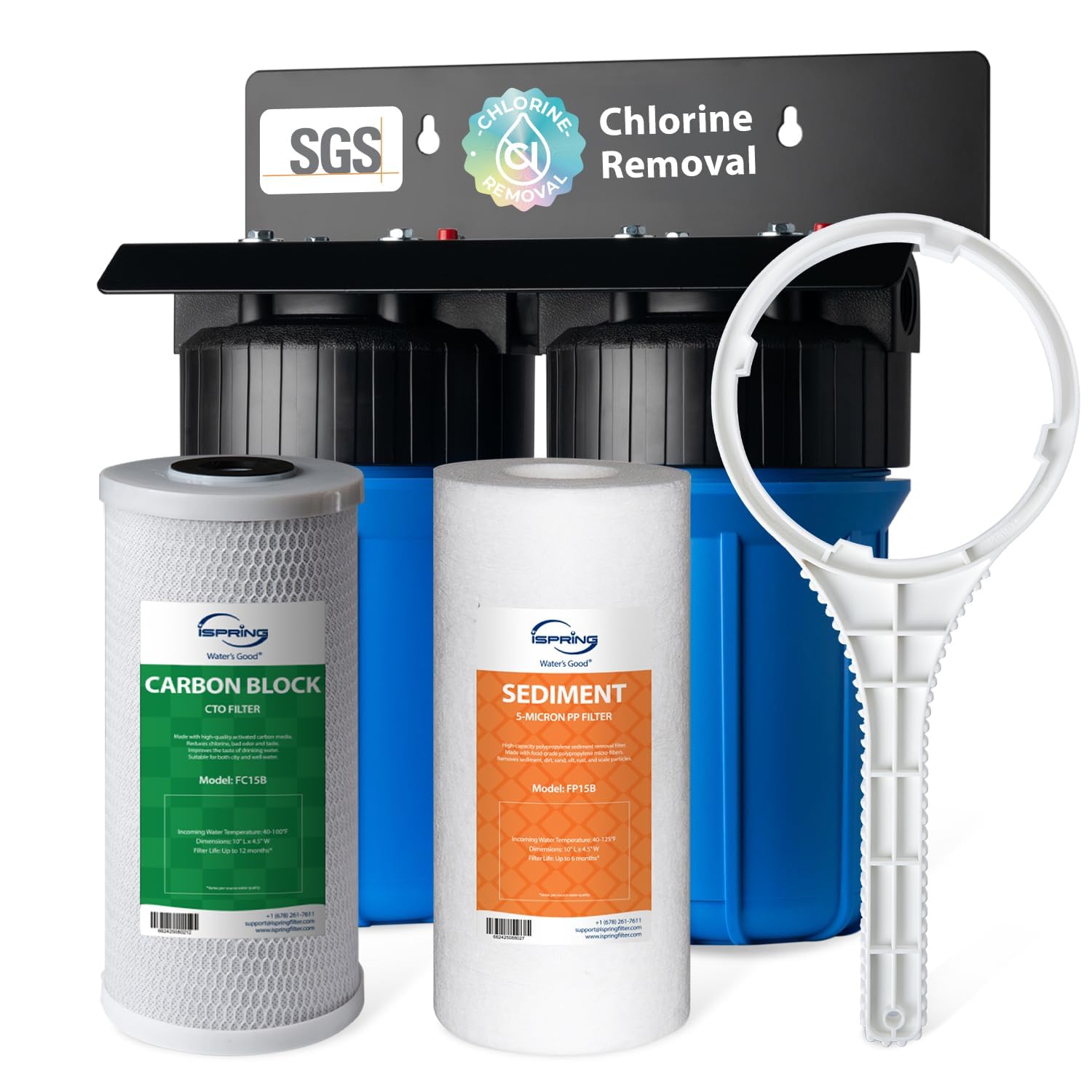
- Best for: Budget whole-house filtering
- Stages: 2
- Addresses: Sediment, chlorine, VOCs
- Brand: iSpring
This post may contain affiliate links. As an Amazon Associate we earn from qualifying purchases.
| Award | Product | APT Score About LAT ScoreThe APT Score is our own rating from 0 to 10, based on performance, design and build, ease of use, and value. It reflects independent research and is never influenced by manufacturers, retailers, or affiliate commissions. Learn more › | Price | |
|---|---|---|---|---|
| Best Overall |
iSpring WGB32B 3-Stage Whole House Water Filter
|
8.9/10 | $420.00 | Buy |
| Best Budget |
iSpring WGB21B 2-Stage Whole House Water Filter
|
8.8/10 | $155.99 | Buy |
| Top Rated |
A.O. Smith AO-WH Whole House Water Filter
|
8.3/10 | $399.00 | Buy |
iSpring WGB32B 3-Stage Whole House Water Filter
This commercial-grade system provides chlorine-free water for the entire home, removing up to 99% of chlorine, sediment, and odors while preserving healthy minerals. Its high flow rate and DIY-friendly design make it a strong candidate for homeowners seeking a tankless, whole-house solution.
Pros
- Effectively removes chlorine, sediment, and bad tastes/odors
- High flow rate (15 GPM) suitable for whole-home use
- DIY installation supported with manual and video guides
- Maintains beneficial minerals unlike reverse osmosis systems
- Includes extended warranty and lifetime tech support with registration
Cons
- Large physical footprint requires significant installation space
- Annual filter replacement is a recurring cost and task
iSpring WGB21B 2-Stage Whole House Water Filter
This whole-house system uses a two-stage process to filter sediment and remove chlorine, bad tastes, and odors for every faucet. With a high flow rate and a capacity of up to 50,000 gallons, it's a robust, no-power option for families looking to protect their plumbing and appliances.
Pros
- Comprehensive two-stage filtration tackles sediment and chlorine/VOCs
- High 50,000-gallon capacity and 15 GPM flow rate minimize maintenance and pressure drop
- DIY-friendly installation with pre-assembled bracket and included wrench
- No electricity required for operation
- Retains beneficial minerals, unlike reverse osmosis systems
Cons
- Bulky dimensions (26"L x 19"W x 11"H) require significant installation space
- Filter replacements are a long-term recurring cost
A.O. Smith AO-WH Whole House Water Filter
This whole-house filter system uses a long-lasting central filter to reduce chlorine taste and odor from every tap. It's designed for larger households and offers straightforward DIY installation, though it's not a water softener.
Pros
- Effectively reduces chlorine taste and odor by 96.9%
- Very long filter life rated for 6 years or 600,000 gallons
- Includes components for DIY installation, no plumber needed
- NSF/ANSI 42 certified for chlorine reduction
- No drainage, back flushing, or water waste during operation
Cons
- Does not reduce TDS, sulfur, or iron
- Not a water softening system
- Requires some additional tools for installation
Best Whole House Water Filters Buying Guide
Filtration Stages and Performance
Whole-house filters typically use two or three stages to target different contaminants.
A two-stage system usually includes a sediment pre-filter to catch large particles like sand and rust, followed by a carbon block or granular activated carbon (GAC) stage that reduces chlorine, taste, and odor.
Three-stage systems add a second carbon cartridge or a specialty filter (e.g., for lead or cyst reduction) for more thorough treatment.
When evaluating performance, look for certified reduction claims (NSF/ANSI standards 42 and 53) and micron ratings. A 5-micron sediment filter is common for well water, while a 1-micron absolute carbon block offers better fine-particle and chemical removal.
If you have specific concerns like heavy metals or PFAS, consider a system with specialized media. For a deeper dive on well-water setups, read our guide to best whole house water filters for well water.
Flow Rate and Capacity
Flow rate, measured in gallons per minute (GPM), determines how many fixtures you can run simultaneously without pressure drop. Most homes need 5, 15 GPM depending on household size and number of bathrooms.
Larger homes or those with high-demand appliances (like a washing machine and two showers running) should choose a system rated for 10+ GPM.
Capacity, often listed in total gallons before filter replacement, affects long-term cost. A 50,000-gallon capacity may last a year for an average family, while higher-capacity systems can go 2, 3 years.
Check replacement filter prices and availability, some brands offer bundled replacements that lower per-gallon cost. For budget-conscious buyers, our best whole house sediment filters for hard water guide covers economical options for sediment removal.
Filter Lifespan and Replacement Costs
Filter longevity varies by water quality and usage. Sediment pre-filters may need changing every 3, 6 months, while carbon filters last 6, 12 months on average.
Some systems use large-format cartridges (e.g., 20″ x 4.5″) that hold more media and last longer, but they cost more upfront. Others use standard 10″ housings that are widely available and cheaper to replace.
Factor in the annual replacement cost when comparing systems. A low initial price can be misleading if filters are expensive or hard to find. Many manufacturers offer subscription programs that simplify reordering.
If you’re considering combining filtration with softening, see our best water filtration and softener systems for home roundup.
Installation and Maintenance
Most whole-house filters require basic plumbing skills: cutting into the main water line and installing shut-off valves and a mounting bracket. Kits with push-fit connections or color-coded tubing simplify the process for DIYers.
Some models are designed for indoor installation (near the water meter or pressure tank), while others can be mounted outdoors with weather protection.
Maintenance mainly involves periodic filter changes and occasionally cleaning the housing. Look for systems with transparent sumps so you can visually inspect sediment buildup. If you’re not handy, consider hiring a plumber, installation costs typically range from moderate to high.
For homes with UV concerns, we recommend reading our best whole house UV water treatment systems guide.
Certifications and Water Quality
NSF/ANSI certifications provide independent verification of a filter’s contaminant reduction claims. Standard 42 covers aesthetic effects (chlorine taste and odor), while Standard 53 covers health-related contaminants (lead, cysts, VOCs). Some filters also carry NSF/ANSI 372 for lead-free materials or NSF/ANSI 401 for emerging compounds like pharmaceuticals.
Always check your water quality report (available from your municipality or a well evaluation kit) before purchasing.
A whole-house filter is a great starting point, but for specialized needs, like removing fluoride or arsenic, you may need a dedicated under-sink system. For point-of-use options, see our best faucet water filter for every kitchen article.
Why You Should Trust Us
AirpurifierTop Review evaluates each whole house water filter using a consistent methodology and scores it on our 0, 10 APT Scale.
Our research combines official specifications, consensus from professional reviewers, verified buyer feedback from multiple retail platforms, and published data from manufacturers and independent labs.
We do not conduct our own product trials; our evaluations are grounded in research, published data, expert review consensus, and verified buyer feedback. This approach ensures our recommendations are objective and transparent.
We update our guides regularly to reflect new models, price changes, and evolving consumer needs. Our team has years of experience covering home water treatment and related categories.
For more on how we evaluate products, explore our best large water filter pitchers for families guide, which follows the same rigorous process.
Final Thoughts
- Best Overall: iSpring WGB32B Commercial-Grade Whole House Water Filter System, With a 3-stage design, high flow rate, and durable metal housing, this system earned the highest APT Score in our lineup. It handles sediment, chlorine, and taste issues effectively for most households.
- Best Value: iSpring WGB21B 2-Stage Whole House Water Filtration System, Offering excellent filtration at a budget-friendly price, this 50,000-gallon system is a smart pick for those who need reliable performance without breaking the bank.
- Best for High Capacity: A. O. Smith Whole House Water Filter System (AO-WH-Filter), With a 600,000-gallon capacity, this model is ideal for large families or homes with heavy water usage. Its durable construction and long filter life reduce maintenance frequency.
Frequently Asked Questions
How often should I replace the filters in a whole house water filter?
It depends on your water quality and usage. Sediment pre-filters typically need changing every 3, 6 months, while carbon filters last 6, 12 months. Some systems have indicator lights or pressure gauges that signal when replacement is due. Always follow the manufacturer’s recommendations and inspect filters regularly.
Can a whole house water filter remove chlorine and sediment?
Yes. Most whole-house systems include a sediment filter to catch particles and a carbon filter to reduce chlorine taste and odor. For optimal chlorine reduction, choose a system with a high-quality carbon block or GAC stage certified to NSF/ANSI 42.
If you also need to remove chloramine, look for specialized catalytic carbon media.
Do I need a water softener in addition to a whole house filter?
It depends on your water hardness. Whole-house filters remove sediment and chemicals but do not soften water (remove calcium and magnesium).
If you have hard water (above 7, 10 grains per gallon), a separate softener is recommended to prevent scale buildup in pipes and appliances.
Some systems combine filtration and softening, our best water filtration and softener systems for home guide covers integrated units.
What is the difference between 2-stage and 3-stage filtration?
A 2-stage system typically has a sediment pre-filter and a carbon filter. A 3-stage system adds a second carbon stage or a specialty cartridge (e.g., for lead or cysts).
Three-stage systems offer more thorough contaminant reduction, especially for well water or high-chlorine municipal supplies. However, they cost more and require more frequent filter changes.
How do I choose the right size whole house water filter?
Consider your household’s peak water demand (GPM) and the space available for installation. Measure your main water line size (typically 3/4″ or 1″) and choose a system with compatible fittings.
Larger filter housings (20″ x 4.5″) provide higher capacity and lower pressure drop, making them suitable for larger homes. For a quick overview of sizing, check our best whole house sediment filters for hard water guide.
About the author
Senior Editor, Air Purifiers. Marcus covers air purifiers. His guides compare filter type, room-size ratings, noise levels, running costs and replacement filter prices, and explain what each spec on the box actually means.