The Best Water Filter Pitchers for Fluoride Removal
Fluoride survives a normal carbon pitcher, so we compared certified media, real cartridge life, and running costs to find the models worth counter space.
 By Hannah Brooks
Updated November 5, 2026
Fluoride in tap water quietly splits households. Some people want it left alone, others want it reduced, and plenty of us simply dislike the flat, faintly metallic taste it leaves behind.
Municipal supplies are dosed on purpose, so an ordinary carbon pitcher will barely touch it.
You need a medium that actually binds fluoride, usually activated alumina or a dedicated ion exchange resin, plus an honest figure for how long that medium keeps working.
Where hardness is the bigger headache at home, salt-free water softeners solve a different problem entirely.
AirpurifierTop Review builds recommendations from research synthesis rather than one reviewer’s kitchen tap.
We read published specifications, cross-checked certification listings, and combed verified buyer feedback for patterns that surface months after delivery, such as slowing flow, cartridge availability, and hairline cracks around the lid.
The shortlist below covers the best water filter pitchers for fluoride removal across budgets and household sizes, ordered by how well each model balances fluoride reduction against capacity, running cost, and daily usability.
The 3 Best Water Filter Pitchers for Fluoride Removal on Our Shortlist (November 2026)

- Best for: Large households
- Capacity: 35 cups
- Fluoride: Over 90% reduction (maker claim)
- Type: Gravity-fed dispenser

- Best for: Broad contaminant coverage
- Contaminants: 386+ listed, incl. fluoride
- Capacity: 80 oz
- Type: Countertop pitcher

- Best for: Lower-cost fluoride reduction
- Capacity: 10 cups
- Filter life: 75 days
- Also reduces: Chlorine, lead
This post may contain affiliate links. As an Amazon Associate we earn from qualifying purchases.
| Award | Product | APT Score About LAT ScoreThe APT Score is our own rating from 0 to 10, based on performance, design and build, ease of use, and value. It reflects independent research and is never influenced by manufacturers, retailers, or affiliate commissions. Learn more › | Price | |
|---|---|---|---|---|
| Best Overall |
 Hskyhan Alkaline Water Filter Pitcher with 2 |
8.6/10 | $26.99 | Buy |
| Best Premium |
 Alkanatur Alkaline Water Pitcher with Magnesium |
8.4/10 | $89.00 | Buy |
| Best Value |
 Santevia MINA Alkaline Water Filter Pitcher |
8.3/10 | $59.99 | Buy |
| Top Rated |
 Seychelle pH2O Alkaline Water Filter Pitcher |
8.3/10 | $79.95 | Buy |
| Best Budget |
Reshape Water RWP-1 10-Cup Filter Pitcher
|
8.1/10 | $35.95 | Buy |
| Also Great |
Waterdrop WD-WFD-02 35-Cup Fluoride Reduction
|
8.1/10 | $49.97 | Buy |
| Also Great |
 OWIARA Water Filter Pitcher with Digital Display |
8.0/10 | $38.98 | Buy |
| Also Great |
Clearly Filtered P-V3 Water Filter Pitcher, 80-Oz
|
8.0/10 | $109.99 | Buy |
| Also Great |
 Culligan ZEROD40 40-Cup Glass Water Filter |
7.8/10 | $89.99 | Buy |
| Most Popular |
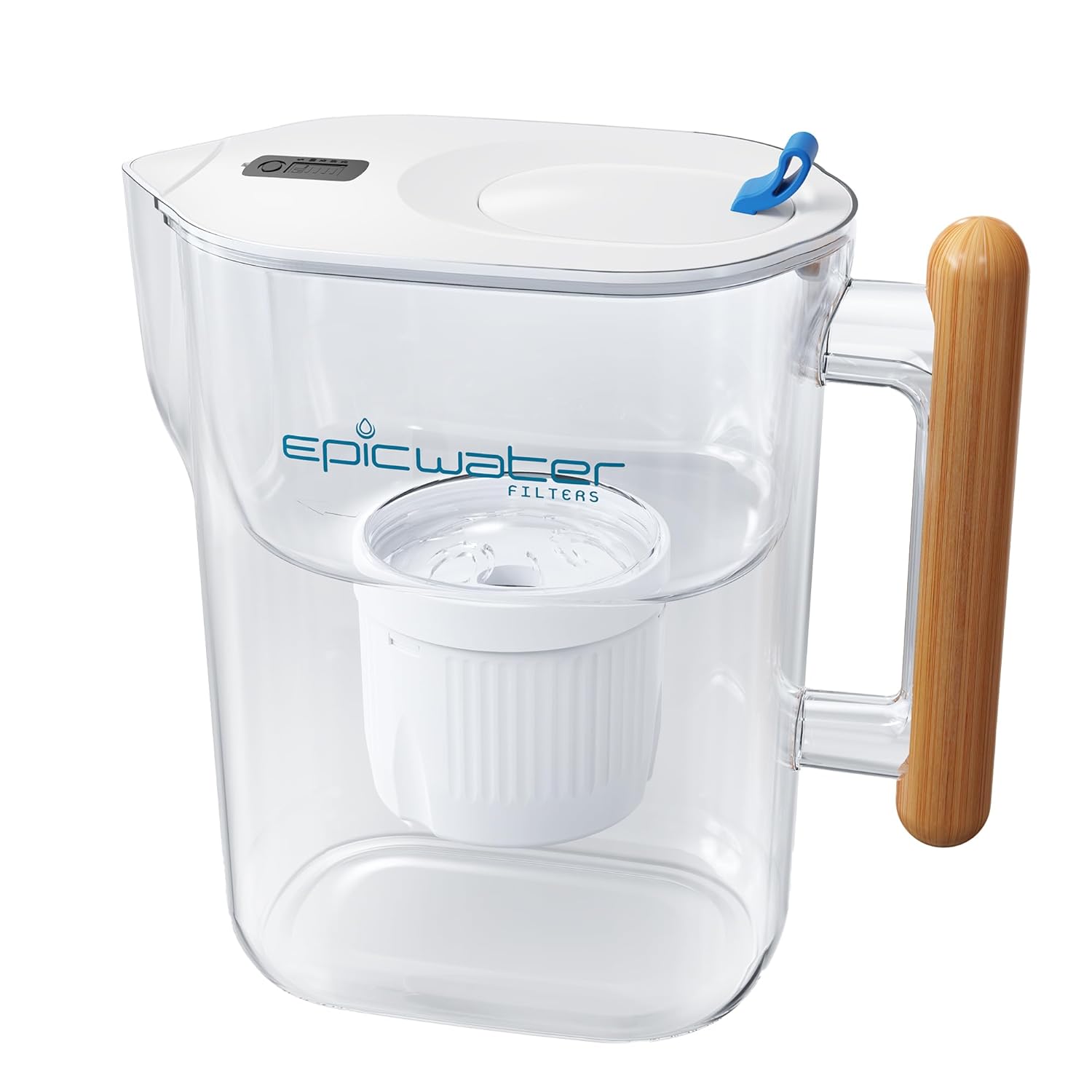 Epic Pure EW-PTCH 10-Cup Water Filter Pitcher |
7.6/10 | $82.00 | Buy |
Hskyhan Alkaline Water Filter Pitcher with 2
This BPA-free pitcher uses a seven-stage alkaline filter to raise water pH and remove common contaminants like chlorine and fluoride. Its 3.5-liter capacity and included filter timer make it a convenient choice for households looking to reduce plastic bottle waste.
Pros
- Large 3.5-liter capacity
- Comes with two filters and a replacement timer
- BPA-free construction with SGS certification
- Seven-stage filtration removes chlorine, fluoride, lead, and odors
- Raises water pH level
Cons
- Requires manual filling and pouring
- Filter life and flow rate depend on source water quality
Alkanatur Alkaline Water Pitcher with Magnesium
This BPA-free alkaline water pitcher uses patented bioceramic filters to remove contaminants like PFAS and fluoride while adding magnesium and antioxidants. It's a premium choice for those seeking certified, sodium-free alkaline water without an ion exchange system. The slim design fits most refrigerator doors.
Pros
- Certified to remove over 99% of contaminants including PFAS and fluoride
- Adds magnesium and creates antioxidant water without adding sodium
- Long-lasting filter good for 105 gallons (3-4 months)
- Offers three filter types to match specific water conditions
- Independent tank design keeps filtered and unfiltered water separate
Cons
- Slower filtration rate at 1 liter every 4 minutes
- Small 1.4-liter capacity may require frequent refilling
Santevia MINA Alkaline Water Filter Pitcher
This pitcher filter uses a two-stage process to reduce chlorine and lead while adding back essential minerals and raising water pH. It's designed for those who want mineralized, alkaline water from a simple, no-installation countertop system.
Pros
- Adds beneficial minerals like calcium and magnesium back into filtered water.
- Raises water pH, producing alkaline water.
- Reduces impurities like chlorine and lead.
- No power or installation required; a simple manual pour-over system.
- Includes a 30-day money-back guarantee.
Cons
- Filter requires replacement every two months.
- Plastic construction may not appeal to all users.
- Limited to a 2-liter (9-cup) capacity per fill.
Seychelle pH2O Alkaline Water Filter Pitcher
A 64-ounce water pitcher with a USA-made alkaline filter designed to raise water pH and remove a range of contaminants like lead and VOCs. It's positioned as a budget-conscious alternative to expensive alkaline water systems, suitable for users seeking mineralized, better-tasting water for beverages.
Pros
- Enhances water pH to an alkaline level, which some users prefer for taste.
- Effectively filters a wide array of contaminants, including heavy metals and chemicals.
- Long filter life rated for 200 gallons of water.
- Manufactured in an ISO-certified facility in the USA.
- Cost-effective compared to high-end alkaline water machines.
Cons
- The plastic construction, while described as non-leaching, may not appeal to all users.
- Requires countertop space for use and storage.
- Alkaline water benefits are based on specific health claims that may not be universally accepted.
Reshape Water RWP-1 10-Cup Filter Pitcher
This 10-cup pitcher from Reshape Water focuses on affordable, certified filtration. It's designed for households looking to reduce fluoride, chlorine, and VOCs while increasing water's pH and adding minerals, all with a budget-friendly filter replacement cost.
Pros
- Certified filters remove or reduce fluoride, chlorine, lead, and VOCs.
- Filter replacements cost 25-33% less than comparable pitchers.
- Increases water pH and adds alkalizing minerals like magnesium and calcium.
- Each filter lasts up to 75 days or 300 liters.
- Constructed from heavy-duty ABS plastic for durability.
Cons
- Filter life of 75 days may require more frequent changes than some competitors.
- Maximum supported water TDS level of 300 PPM may not suit all water sources.
Waterdrop WD-WFD-02 35-Cup Fluoride Reduction
This large-capacity water filter dispenser targets households concerned about fluoride, reducing over 90% of it along with chlorine and other impurities. Its 35-cup capacity and space-saving design make it a practical countertop or fridge option for families. The two-month filter lifespan also promises savings compared to bottled water.
Pros
- Effectively reduces over 90% of fluoride, chlorine, and other impurities
- Large 35-cup capacity suitable for family use
- Space-saving design fits easily on a counter or in a refrigerator
- Two-month filter lifespan offers cost savings versus bottled water
Cons
- Requires regular filter replacements every two months
- Plastic construction may be a concern for some buyers
OWIARA Water Filter Pitcher with Digital Display
This 3.2-liter alkaline water pitcher uses a 5-stage filter to reduce TDS and raise pH. Its standout feature is a digital display that tracks filter life, aiming to simplify maintenance. It's a manual, BPA-free option for households seeking an alternative to bottled water.
Pros
- Digital filter life display for more accurate replacement reminders
- 5-stage alkaline filter designed to remove various contaminants and raise pH
- BPA-free construction and a dust-proof filter cap
Cons
- Filter requires a lengthy 45-60 minute soak before first use
- Relatively short recommended filter life of about two months
Clearly Filtered P-V3 Water Filter Pitcher, 80-Oz
This NSF-certified pitcher offers comprehensive contaminant reduction, targeting over 386 substances like fluoride and PFAS while preserving beneficial minerals. Its 80-ounce family-sized capacity and medical-grade Tritan construction make it a robust, health-focused choice for households concerned about tap water quality.
Pros
- Extensive contaminant removal (386+ including fluoride, lead, PFAS)
- Large 80-ounce capacity suitable for families
- Made from premium, BPA/BPS-free medical-grade Tritan plastic
- Long-lasting filter rated for 100 gallons or about 4 months
- Backed by independent third-party evaluation and NSF certifications
Cons
- Manual pour operation requires physical handling
- Filter has a defined shelf life of 120 days
Culligan ZEROD40 40-Cup Glass Water Filter
This glass water filter dispenser combines a large 40-cup capacity with a certified 5-stage filter designed to tackle a broad range of contaminants, including PFAS and lead. The included TDS meter provides a clear visual indicator of filter performance, making it a practical choice for households seeking a high-volume, countertop filtration solution.
Pros
- Certified to reduce a wide range of contaminants, including PFAS and lead
- Includes a TDS meter for monitoring filter effectiveness
- Large 40-cup capacity suitable for families or entertaining
- Glass construction reduces plastic waste
Cons
- Gravity-powered filtration has a relatively slow flow rate
Epic Pure EW-PTCH 10-Cup Water Filter Pitcher
This BPA-free pitcher offers comprehensive filtration, targeting concerning contaminants like PFAS, lead, and microplastics. Its 100-gallon filter life and integrated timer are practical for household use. The fridge-friendly design suits those prioritizing chemical reduction over speed.
Pros
- Effectively reduces a wide range of contaminants, including PFAS and lead.
- Filter life of 100 gallons, replacing many single-use bottles.
- Convenient filter timer built into the lid.
- Fridge-friendly and BPA-free Tritan construction.
Cons
- Requires patience for full filtration before pouring.
- Lid may be prone to slipping when the pitcher is wet.
Best Water Filter Pitchers for Fluoride Removal Buying Guide
Fluoride Removal Claims and Certification
Fluoride is a small, stable ion, and granular activated carbon on its own barely dents it.
Pitchers that genuinely reduce it lean on activated alumina, bone char, or a resin blend, and the credible brands publish a percentage reduction next to the conditions behind it. Treat any number without context with suspicion.
A claim of 90 percent or more means something only when it names the protocol, the water volume, and the point in the cartridge’s life at which it was measured, because fluoride capacity falls away well before the filter stops improving taste.
Third-party certification from NSF/ANSI 42, 53, or 401 is the quickest way to separate chemistry from copywriting. Standard 53 covers health related contaminants, 42 covers taste and odour, and 401 adds emerging compounds.
A pitcher whose listing carries a certification number you can look up is worth more than one quoting a house figure.
If complete removal is the goal, say for mixing formula on a doctor’s advice, distillation reaches zero, and our guide to water distillers walks through the energy and time costs.
Capacity, Footprint, and Fridge Fit
Manufacturers quote total volume, but what matters is usable filtered water.
A 10 cup pitcher typically holds about 6 to 8 cups of finished water because the upper reservoir occupies the rest, so a couple drinking three glasses each per evening will refill once a day.
Families of four or more should look at dispenser designs in the 20 cup and above range rather than topping up a small jug all evening.
Measure before you buy. Fridge door bins steal height, and a tall pitcher with a raised handle will not slide under a low shelf. On a countertop, check the pour spout clearance under upper cabinets.
Campers and van dwellers have a different constraint, since every litre has to justify its space, and dedicated RV water filters for campground water often make more sense than a full size pitcher for those trips.
Somewhere in between sits a high capacity dispenser with a spigot. It stays put on the counter, serves a whole household without lifting, and turns a twice hourly refill habit into a once a day chore.
Filter Life and True Cost of Ownership
Cartridge ratings in gallons are a starting point, not a promise. Chlorine reduction usually outlasts fluoride reduction, so if fluoride is your reason for buying, replace on the fluoride schedule even when the indicator still shows life.
Buyers who report the sharpest drop off in performance often admit they stretched a cartridge several extra weeks past the recommended swap.
Do the annual arithmetic before committing. Divide your household’s daily filtered intake by the rated capacity to estimate cartridges per year, then multiply by the replacement price.
A cheap pitcher with short lived cartridges can cost more across three years than a premium model with long intervals.
Check that refills are stocked by mainstream retailers and sold in multi packs, and be wary of marketplace listings that undercut the official price sharply, since counterfeit filter media is a genuine problem in this category.
Materials, Taste, and What Else Comes Out
Reservoir plastic should be BPA free and food safe, and the better models name the resin, usually Tritan or a similar copolyester. Glass dispensers avoid plastic contact entirely but weigh a great deal when full.
Whatever you choose, expect a few days of slightly odd tasting water while carbon fines wash out, then a clean, flat profile that most people read as fresh.
Fluoride is rarely the only concern. A good pitcher also pulls chlorine, lead, sediment, and in some cases PFAS, which is why certification matters more than a long bullet list.
A softener, by contrast, targets calcium and magnesium rather than fluoride, and budget water softeners tackle scaling without changing fluoride at all.
Mineral adding pitchers raise pH and put magnesium or calcium back in, which some drinkers prefer for taste and others find chalky. None of that changes fluoride performance either way.
Housekeeping matters too. Rinse the reservoir weekly with mild soap, dry the lid gasket properly, and descale monthly if your supply is hard. A steam cleaner makes short work of the surrounding kitchen surfaces without leaving detergent residue that can taint a freshly filled pitcher.
Flow Rate, Pouring, and Daily Handling
Gravity pitchers are slow by design. Expect several minutes for a full reservoir, longer once a cartridge nears the end of its life. If you fill the pitcher straight from the tap each morning, that wait disappears into the routine.
If you are topping up a single glass at a time, a slow model becomes an irritation, so check stated flow rates or buyer comments about fill time before you commit.
Small design decisions separate a pitcher you keep from one that ends up in a cupboard.
A wide handle that clears the fridge shelf, a spout that cuts off cleanly instead of dribbling, a lid that lifts off one handed, and a filter indicator that counts volume rather than blinking on a timer all matter more after week six than they do on the spec sheet.
Why You Should Trust Us
Every product on this page is scored with the APT Score, a 0 to 10 rating we apply across categories using one consistent set of criteria: fluoride and contaminant reduction evidence, certification status, capacity and footprint, running cost, build quality, and long term owner reports.
Scores are assigned after weighing each factor, not by averaging star ratings or copying a spec sheet.
We do not conduct our own product trials; our evaluations are grounded in research, published data, expert review consensus, and verified buyer feedback.
When a claim cannot be traced to a certification listing or a documented protocol, we say so in the write up rather than repeating the marketing.
AirpurifierTop Review is reader supported. If you buy through a link on this page we may earn a commission, and that has no bearing on which models make the shortlist or how they are rated.
We do not sell products, handle orders, or administer warranties. The same research first approach runs through the rest of our home coverage, including air purifiers for large rooms and the water treatment guides linked throughout this article.
Final Thoughts
Fluoride removal is a chemistry question first and a convenience question second. Pick the medium that actually binds fluoride, confirm it with a certification you can verify, then size capacity and running cost around your household. These five stand out for different reasons.
- Best Overall: Hskyhan Alkaline Water Filter Pitcher holds the highest APT Score in this group by pairing a seven stage cartridge with a generous reservoir and a genuinely modest entry price, which is why it suits most kitchens.
- Best for Certified Contaminant Removal: Clearly Filtered Water Filter Pitcher is the pick when you want third party verification across the widest spread of contaminants and are willing to pay for the cartridge.
- Best for Low Running Costs: 10-Cup Pitcher with 6-Stage Filter keeps replacement cartridges meaningfully cheaper than the category norm, so the savings compound over a couple of years of daily use.
- Best for Large Households: Waterdrop WFD-02L 35-Cup Water Filter Dispenser removes the refill treadmill for big families while keeping fluoride reduction in the specification sheet.
- Best for Mineral Enhanced Water: Alkanatur Alkaline Water Filter Pitcher adds magnesium while still reducing fluoride, a sensible middle path for drinkers who find plain filtered water thin.
Whichever you choose, soak and prime the first cartridge exactly as the manual instructs and discard the first two fills. That step activates the carbon properly and avoids the earthy note that makes people give up on a new pitcher in the first week.
Frequently Asked Questions
Does a water filter pitcher really remove fluoride?
It can, but only if the cartridge is built for it. Standard carbon pitchers sold on taste alone remove chlorine and odours and leave fluoride largely untouched.
Look for activated alumina or a dedicated fluoride medium alongside a certification reference, and replace the cartridge on the fluoride interval rather than waiting for the taste to change.
How often should I change the filter?
Follow the manufacturer’s fluoride rating rather than the longer taste rating. In a two person household most cartridges land in the two to three month bracket, while heavy use in a family of five can halve that.
Write the install date on the cartridge with a marker, because indicators vary widely in how they count volume and time.
Is a certified pitcher worth the extra money?
If fluoride or lead is your reason for buying, yes. Certification means an independent body reviewed the reduction claims against a specific water volume, which is the closest thing to a guarantee in this market.
If you only want better tasting water, a simpler carbon pitcher does that job perfectly well for less.
Can I use filtered water for cooking and for pets?
Absolutely, and it is one of the cheapest upgrades in the kitchen. Filtered water makes clearer stocks, better rice, and more consistent bread dough, and filling a pet bowl from the pitcher is no different from filling a glass.
Ventilation matters as much as water quality when you cook often, so range hoods for gas ranges are worth a look, and steam mops for hardwood floors handle the spills afterwards.
Does fluoride removal change how the water tastes?
Usually for the better, though not for the reason people expect. The drop in chlorine is what most drinkers notice first, since that is the note that reads as a swimming pool smell.
Fluoride itself is largely tasteless at municipal levels, so the improvement comes from everything else the cartridge captures. Mineral adding pitchers then put magnesium or calcium back in, which softens the mouthfeel if you find filtered water thin.
How do I keep the pitcher clean between cartridges?
Rinse the reservoir every week with warm soapy water, air dry it upside down, and skip the dishwasher unless the manual explicitly allows it, since heat warps lids and gaskets.
Once a month, run a descaling soak if your supply is hard.
Pet owners should keep the floor around the filling station clear too, and canister vacuums for pet hair make that routine quicker, while a nightly pass with robot vacuums keeps the counter clear enough to actually use the pitcher.
About the author
Managing Editor & Buying Guides. Hannah oversees the editorial calendar and edits every buying guide. She makes sure each guide states its criteria up front, shows pros and cons side by side, and says who a product is not for.