The Best Reverse Osmosis Systems for Well Water
Well water comes with its own set of challenges. Our research-backed guide compares top-rated reverse osmosis systems designed to handle sediment, hardness, and contaminants common in well water. Find the perfect model for your home.
 By Amara Okafor
Updated November 5, 2026
Well water often carries a unique set of contaminants, from sediment and hardness minerals to iron, manganese, and even bacteria, that municipal systems treat differently.
A dedicated reverse osmosis system can provide a final polishing step to deliver clean, great-tasting water at your kitchen sink.
After analyzing expert reviews, verified buyer feedback, and published specifications, we’ve evaluated the top models designed to handle the challenges of well water.
Below are our picks for the best reverse osmosis system for well water in November 2026, chosen for their filtration stages, flow rates, and overall value.
Whether you’re dealing with hard water stains, a metallic taste, or simply want peace of mind, investing in a quality RO system is one of the most effective ways to improve your household water.
In this guide, we break down the key factors to consider when shopping for a reverse osmosis system for well water and explain why these models stand out based on our research.
For broader well water treatment, you might also want to explore whole house water filters for well water to tackle issues before they reach your RO unit.
The 3 Best Reverse Osmosis Systems for Well Water on Our Shortlist (November 2026)
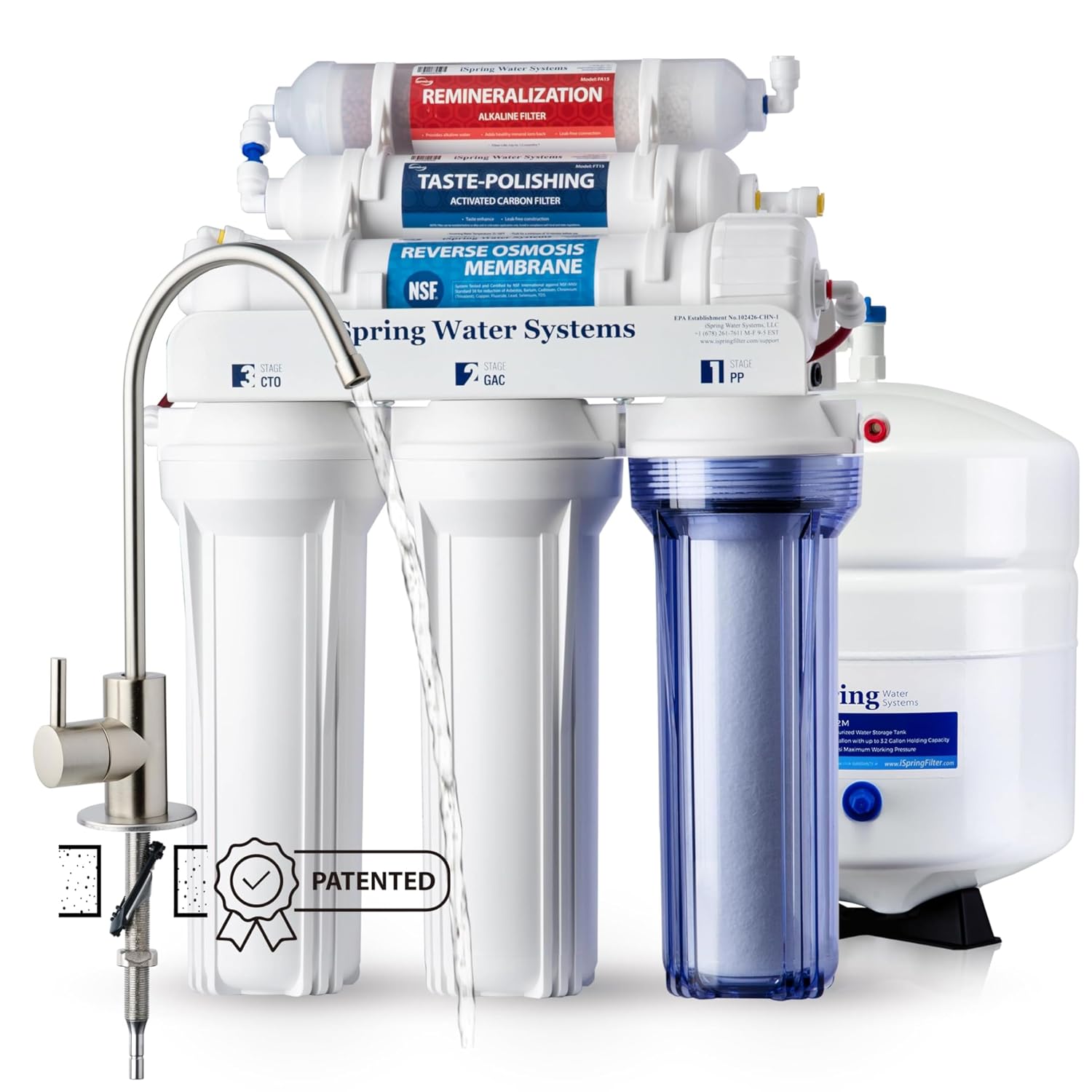
- Best for: NSF-certified under-sink RO
- Stages: 6
- Certification: NSF 58
- Install: Under sink

- Best for: Tankless design, fast flow
- Flow: 400 GPD
- Design: Tankless
- Install: Under sink

- Best for: Proven 5-stage RO
- Stages: 5
- Method: Activated carbon and reverse osmosis
- Install: Under sink
This post may contain affiliate links. As an Amazon Associate we earn from qualifying purchases.
| Award | Product | APT Score About LAT ScoreThe APT Score is our own rating from 0 to 10, based on performance, design and build, ease of use, and value. It reflects independent research and is never influenced by manufacturers, retailers, or affiliate commissions. Learn more › | Price | |
|---|---|---|---|---|
| Best Overall |
iSpring RCC7AK-BN Alkaline 6-Stage RO System
|
8.8/10 | $199.99 | Buy |
| Best Budget |
APEC ROES-50 5-Stage Reverse Osmosis System
|
8.6/10 | $179.99 | Buy |
| Top Rated |
Waterdrop G2 RO System, 400 GPD Tankless
|
8.6/10 | $239.99 | Buy |
iSpring RCC7AK-BN Alkaline 6-Stage RO System
This NSF-certified reverse osmosis system delivers highly purified water with a mineral boost for improved taste and pH. Its patented top-mounted faucet design is a standout feature for anyone dreading a difficult under-sink installation.
Pros
- NSF 58 certified for the entire system, ensuring verified contaminant reduction
- Patented top-mounted faucet simplifies countertop installation
- Alkaline remineralization stage adds healthy minerals back into the water
- Transparent first-stage housing allows for easy filter life monitoring
- Includes a comprehensive set of tools and lifetime technical support
Cons
- Filter life for the primary sediment/carbon stage is only six months
- System has a relatively large footprint under the sink
APEC ROES-50 5-Stage Reverse Osmosis System
This under-sink reverse osmosis system provides high-capacity filtration, delivering up to 50 gallons of purified water per day. It's a comprehensive, DIY-friendly kit well-suited for households seeking a reliable, NSF-certified solution to reduce a wide range of contaminants.
Pros
- Highly effective 5-stage filtration removes a broad spectrum of impurities, including heavy metals and PFAs.
- DIY-friendly installation with quick-connect fittings and clear instructions simplifies setup.
- Includes all necessary components, such as a brushed nickel faucet, tank, and filter set, for a complete solution.
- Backed by over 20 years of manufacturer experience and strong user reviews.
Cons
- The 0.03 GPM flow rate is relatively slow for immediate dispensing.
- Filter replacements are required every 6-24 months, representing an ongoing maintenance cost.
Waterdrop G2 RO System, 400 GPD Tankless
This compact, under-sink reverse osmosis system offers a fast 400-gallon-per-day flow rate and a remarkably efficient 1:1 pure-to-drain water ratio. Its tankless design saves significant cabinet space, though it requires an electrical outlet and some drilling for installation.
Pros
- High 400 GPD flow rate provides water quickly
- Very efficient 1:1 drain ratio reduces water waste
- Tankless, compact design saves under-sink space
- NSF/ANSI 372 certified for lead-free materials
- Easy filter replacement with twist-and-pull design
Cons
- Requires under-sink electricity and drilling
- Filter life cycle is only 6 months
Best Reverse Osmosis System for Well Water Buying Guide
Filtration Stages and Contaminant Removal
The number of stages directly impacts the system’s ability to remove well water contaminants. A standard 5-stage RO system includes sediment and carbon pre-filters, the RO membrane, and a post-filter.
For well water, an additional stage, such as a fluoride filter or alkaline remineralization cartridge, can be beneficial.
The iSpring RCC7AK-BN, for example, adds a sixth alkaline stage that restores beneficial minerals while ensuring the removal of up to 99% of over 1,000 contaminants, including lead and chlorine.
When evaluating options, consider whether the system targets the specific impurities present in your water, such as iron, manganese, or hydrogen sulfide. Many homeowners pair their RO system with a water softener to reduce hardness first, prolonging membrane life.
Additional stages like UV sterilization can be added inline for bacterial concerns, but most under-sink RO systems rely on chemical-free filtration. Always check the manufacturer’s contaminant reduction list and NSF certifications for claims about well water contaminants.
Flow Rate and Storage (Tank vs. Tankless)
Flow rate is measured in gallons per day (GPD) and indicates how much water the system can produce.
Traditional systems like the APEC ROES-50 produce 50 GPD and store purified water in a pressurized tank, providing a ready supply but taking up under-sink space.
Tankless designs, such as the Waterdrop G2 with 400 GPD, produce water on demand and have a smaller footprint. For well water users, tankless systems offer the advantage of continuous high flow without the risk of bacterial growth in a tank.
However, they typically require a permeate pump and may have higher initial costs. Consider your household’s daily water consumption and available cabinet space when deciding between sediment filters paired with a tank or a tankless solution.
If you often fill large pots or have a high water usage, a higher GPD tankless model can be more convenient. On the other hand, if water pressure consistency is a concern, a tank-based system may provide a more reliable flow.
Maintenance and Filter Replacement
All RO systems require periodic filter changes to maintain performance. The typical schedule is pre-filters every 6-12 months, RO membrane every 2-3 years, and post-filters annually. Well water, with its higher sediment and mineral load, may require more frequent replacements.
Look for systems with quick-change filter cartridges that simplify maintenance. The iSpring RCC7AK-BN and APEC ROES-50 both use standard 10-inch filters, widely available and affordable. The Waterdrop G2 uses twist-and-lock filters that don’t require a wrench, making changes mess-free.
Keep in mind the ongoing cost of replacement filters; budget-friendly options like the APEC can keep long-term expenses low. For more on maintaining water quality throughout your home, see our guide to water filtration and softener systems for home.
Certifications and NSF Standards
NSF/ANSI certifications assure that a system meets proven material safety, structural integrity, and contaminant reduction claims. For well water, look for NSF 58 (reverse osmosis systems) and NSF 53 (for specific contaminant reduction like lead, cysts, and VOCs).
The iSpring RCC7AK-BN is fully NSF certified for its entire system, including the faucet, a detail that adds trust. The APEC ROES-50 also boasts NSF certification for material safety, though its pre-filters are separately certified.
While the Waterdrop G2 lacks full NSF certification for the whole system, it uses a certified membrane. Always cross-check certification details, especially if you have well water with known contaminants like arsenic or nitrates.
A UV treatment system can be added for microbial protection if needed.
Installation and Space Requirements
Most under-sink RO systems fit in a standard kitchen sink base cabinet, but the presence of a tank can be cramped. Tankless models like the Waterdrop G2 are more compact, leaving room for additional storage.
Installation is generally DIY-friendly if you have basic plumbing skills, typical steps include drilling a hole for the faucet, connecting to the cold water line, and installing a drain saddle.
The iSpring features a patented top-mounted faucet design that simplifies installation and prevents leaks. If you’re not comfortable with plumbing, hiring a professional is recommended.
For reference, pre-treating water with a whole house well water filter can reduce sediment before the RO system, extending its lifespan.
Water Pressure and Compatibility
Standard RO systems require a water pressure of 40-60 psi to operate efficiently. Well water systems often have lower pressure due to pump settings or distance from the well.
If your pressure is below 40 psi, a booster pump may be necessary. The Waterdrop G2 includes a built-in pump that allows it to work with pressures as low as 15 psi, making it ideal for well water applications.
Both the iSpring and APEC models don’t include a pump but can operate down to 40 psi. Verify your household water pressure before purchasing; a pressure gauge is inexpensive.
For extremely low pressure or hard water, combining a water softener can help protect the RO membrane.
Why You Should Trust Us
At AirpurifierTop Review, our goal is to provide unbiased, thoroughly researched recommendations. We do not conduct our own product trials; our evaluations are grounded in research, published data, expert review consensus, and verified buyer feedback.
Each product is assessed against consistent criteria, including filtration performance, build quality, maintenance cost, certifications, and user satisfaction, and assigned an APT Score on a 0 to 10 scale.
This systematic approach helps us identify the best reverse osmosis system for well water based on reliable evidence, not marketing claims. Our team of researchers and editors works independently, and all picks are made without influence from manufacturers or retailers.
We also maintain transparency: this article may contain affiliate links, and we earn a commission on qualifying purchases at no extra cost to you.
Final Thoughts
After careful analysis, here are our top picks for the best reverse osmosis system for well water, each earning a high APT Score in its category.
- Best Overall: iSpring RCC7AK-BN, With six stages, NSF certification for the entire system, and a remineralization filter that restores healthy pH, this model offers the most comprehensive filtration and the highest APT Score in our comparison. It’s a premium choice for well water users who want top-tier performance.
- Best Value: APEC Water ROES-50, This 5-stage system delivers reliable performance at a budget-friendly price point. It’s NSF certified, easy to maintain, and has decades of proven track record, making it a smart pick for homeowners who need solid well water treatment without the high cost.
- Best Tankless Design: Waterdrop G2, With a 400 GPD flow rate, built-in pump for low pressure, and a compact tankless form factor, this system excels where space is tight and pressure is low. It’s ideal for well water environments where consistent pressure is a challenge.
Frequently Asked Questions
Is reverse osmosis effective for well water?
Yes, reverse osmosis is highly effective for well water, removing up to 99% of common contaminants including lead, arsenic, fluoride, nitrates, and many dissolved solids. However, it works best when preceded by sediment filtration and water softening to protect the membrane.
For microbial contaminants, consider adding a UV filter.
Can RO systems remove iron and manganese from well water?
Standard RO membranes can reduce low levels of dissolved iron and manganese, but high concentrations may foul the membrane quickly. A whole house iron filter or water softener should be used upstream. Systems with a sediment pre-filter can also help with larger particles.
How often do I need to change filters on a well water RO system?
Pre-filters should be replaced every 6 to 12 months, the RO membrane every 2 to 3 years, and post-filters annually. Well water may require more frequent changes due to higher sediment and mineral load, monitor pressure gauges and taste for signs. Quick-change cartridges simplify the process.
Do I need a water softener before an RO system for well water?
Not always, but highly recommended. Hard water scales can clog the RO membrane and reduce efficiency. If your well water hardness exceeds 10 grains per gallon, a water softener is advised to protect the system. Many well-owners install both for optimal water quality.
What GPD flow rate is recommended for well water?
For a typical household, 50 GPD (tank-based) or 400+ GPD (tankless) is sufficient. Higher flow rates are convenient but may require adequate water pressure. Well water with moderate sediment might benefit from a tank system that maintains buffer, while tankless works well with low pressure built-in pumps.
Are tankless RO systems better for well water?
Tankless systems can be advantageous for well water because they eliminate the storage tank, reducing bacterial growth risk and saving space.
Many tankless models include built-in pumps that operate at lower pressures, making them a smart fit for well water if you have concerns about water pressure or cabinet space.
About the author
Contributor, Smart Home & Appliance Tech. Amara covers smart features in home appliances, including app control, sensors, voice assistants and automation, and notes when a feature adds real value and when it is a gimmick.