Best Hrv Systems 2026: Reviews & Comparison
Our guide to the best hrv systems for November 2026 covers 10 top-rated models from FANTECH, Broan-NuTone, Generic and more to improve your home's air quality and energy efficiency.
 By Sofia Alvarez
Updated November 12, 2026
Modern, airtight homes are great for energy bills but terrible for indoor air quality. You might be dealing with lingering odors, excessive humidity, or simply feeling stuffy and lethargic because stale air is trapped inside. Choosing the right ventilation solution means balancing three key decisions: finding the correct capacity for your home’s size, ensuring compatibility with your existing HVAC system or space, and considering the noise level for daily comfort.

After evaluating the top models available in November 2026, we find the Aprilaire V22BEC Energy Recovery Ventilator (ERV) to be the best overall choice for most whole-house applications due to its robust capacity and balanced energy recovery. For a smart, single-room solution, the Wi-Fi-Enabled Pioneer 50 Single-Room Wall-Mounted offers excellent targeted ventilation. For broader options, explore our Air Purifiers category for other ways to clean your indoor air.
The 3 Best Hrv Systems on Our Shortlist (November 2026)
- Best for: Whole-house ventilation in large homes
- Coverage: Up to 6,000 sq ft
- Airflow: 120 CFM
- Mounting: Wall, ceiling, or floor

- Best for: High-capacity, high-static pressure applications
- Airflow: 218 CFM
- Defrost: Recirculation
- Duct Size: 6-inch top ports

- Best for: Smart, single-room ventilation
- Control: WiFi & remote
- Heat Recovery: Up to 90%
- Noise Level: Under 30dB
This post may contain affiliate links. As an Amazon Associate we earn from qualifying purchases.
Quick Comparison
| Award | Product | APT Score About LAT ScoreThe APT Score is our own rating from 0 to 10, based on performance, design and build, ease of use, and value. It reflects independent research and is never influenced by manufacturers, retailers, or affiliate commissions. Learn more › | Price | |
|---|---|---|---|---|
| Best Value |
 Broan AI B160H65RS 150 CFM Heat Recovery |
8.1/10 | $1,021.00 | Buy |
| Best Overall |
Aprilaire V22BEC ERV Whole-House Ventilator
|
9.4/10 | $1,290.38 | Buy |
| Most Popular |
Weiworld VT501-WF 6-Inch Heat Recovery Ventilator
|
7.3/10 | $339.99 | Buy |
| Also Great |
 Panasonic FV-06VE1 WhisperComfort 60 ERV |
7.3/10 | $629.50 | Buy |
| Also Great |
 Fantech VHR 150 HRV Unit |
7.0/10 | $1,112.00 | Buy |
| Top Rated |
 Fantech AEV80 Air Exchanger Ventilator with MERV8 |
8.1/10 | $733.92 | Buy |
| Also Great |
 Pioneer ERV150AHRPM25L Ductless Energy Recovery |
7.5/10 | $1,088.00 | Buy |
| Best Premium |
 Fantech VHR70R ES 70 CFM Heat Recovery Ventilator |
7.5/10 | $1,191.10 | Buy |
| Best Budget |
 Pioneer ERV-50 Wall-Mounted Energy Recovery |
8.1/10 | $468.00 | Buy |
| Also Great |
Fantech HERO 200H Heat Recovery Ventilator
|
$2,166.24 | Buy |
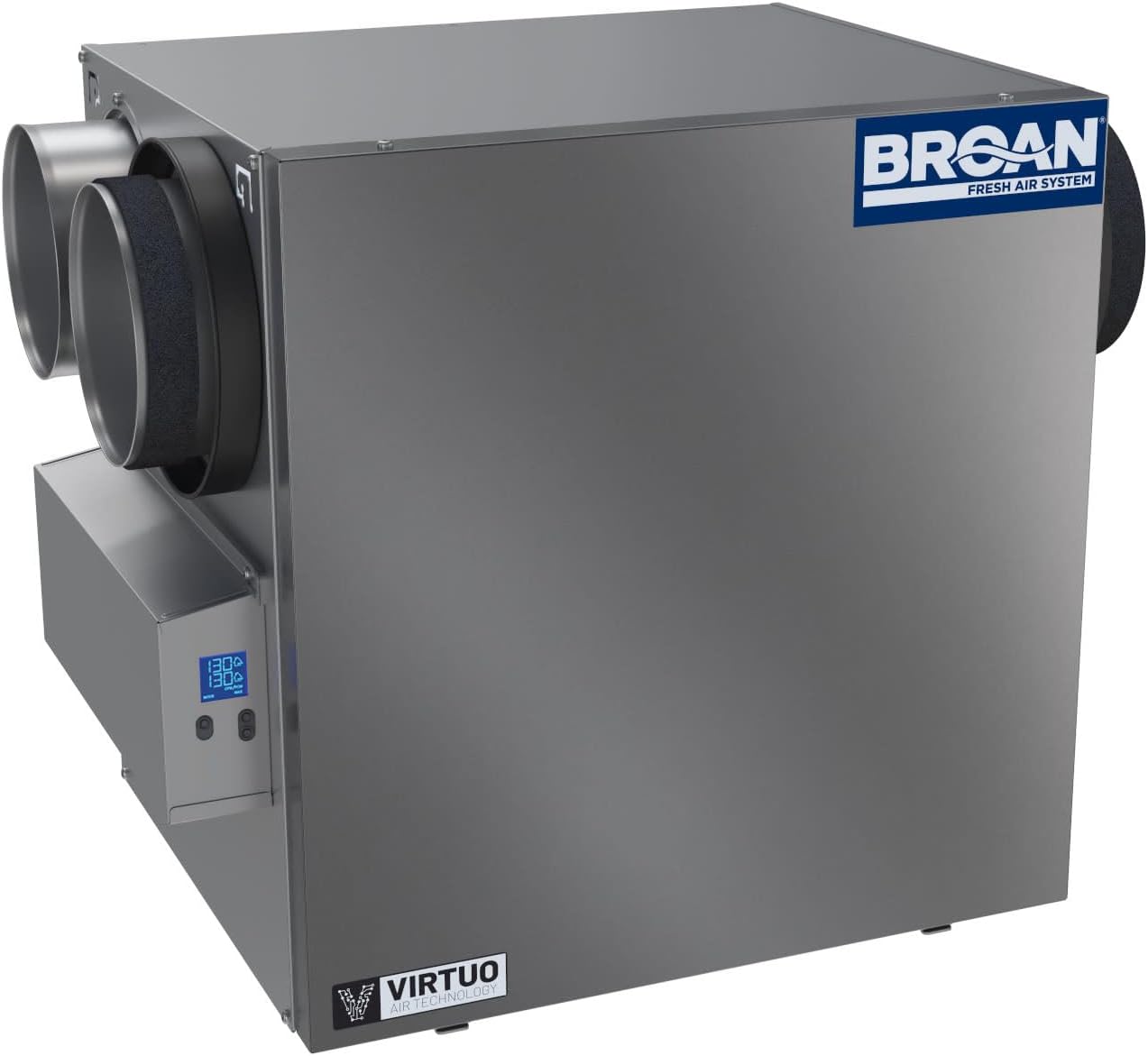
Broan AI B160H65RS 150 CFM Heat Recovery
This Broan-NuTone wall or ceiling mounted HRV is designed for medium to large homes, featuring VIRTUO™ Air Technology for automated fresh air management. Its auto-balancing and compact design aims to simplify installation and operation.
Pros
- Features VIRTUO™ Air Technology that monitors conditions to provide fresh air automatically.
- Offers flexible mounting (wall or ceiling) and auto-balancing for easier installation.
- Includes MERV 8 filters with an optional MERV 13 upgrade for improved filtration.
- Uses energy-efficient PMSM ECM motors, claimed to save up to 60% energy.
- Integrated LCD screen provides real-time airflow data and diagnostic codes.
Cons
- The unit is relatively large and heavy, which may complicate handling during installation.
- Requires a dedicated 120V power source, which may limit placement options.
- Its 2016 start year suggests it may not incorporate the very latest component designs.
Aprilaire V22BEC ERV Whole-House Ventilator
This whole-house energy recovery ventilator is designed to improve indoor air quality in homes up to 6,000 square feet by continuously exchanging stale indoor air with fresh, tempered outdoor air. Its flexible mounting options and straightforward controls make it a practical solution for both new builds and retrofits, particularly in climates where balancing humidity and temperature is a priority.
Pros
- Effectively replaces stale indoor air to reduce odors and pollutants.
- Energy recovery core helps lower HVAC load for potential cost savings.
- Flexible installation with wall, ceiling, or floor mount bracket.
- Simple push-button controls for easy operation.
Cons
- At 53 dB, it may produce noticeable operational noise.
- Installation, while templated, is still a significant project requiring professional skills.
- Large physical footprint may require dedicated indoor space.
Weiworld VT501-WF 6-Inch Heat Recovery Ventilator
This wall-mounted HRV uses a ceramic core to recover up to 90% of heat from outgoing air, aiming to improve air quality while reducing energy costs. Its WiFi and remote control offer convenient operation from anywhere. It's a versatile unit suitable for a single room in apartments, home offices, or workshops.
Pros
- High-efficiency ceramic heat exchanger recovers up to 90% of heat energy
- Smart WiFi and remote control via Tuya app for flexible management
- Energy-efficient 8.5W EC motor operates quietly under 30dB
- Three airflow modes (Fresh Air, Exhaust, Recirculation) for different needs
- Flexible installation fits wall thicknesses from 250mm to 500mm
Cons
- With a 3.7-star average from 39 reviews, user satisfaction appears mixed
- Airflow capacity of 60 cubic meters per hour is modest for larger spaces
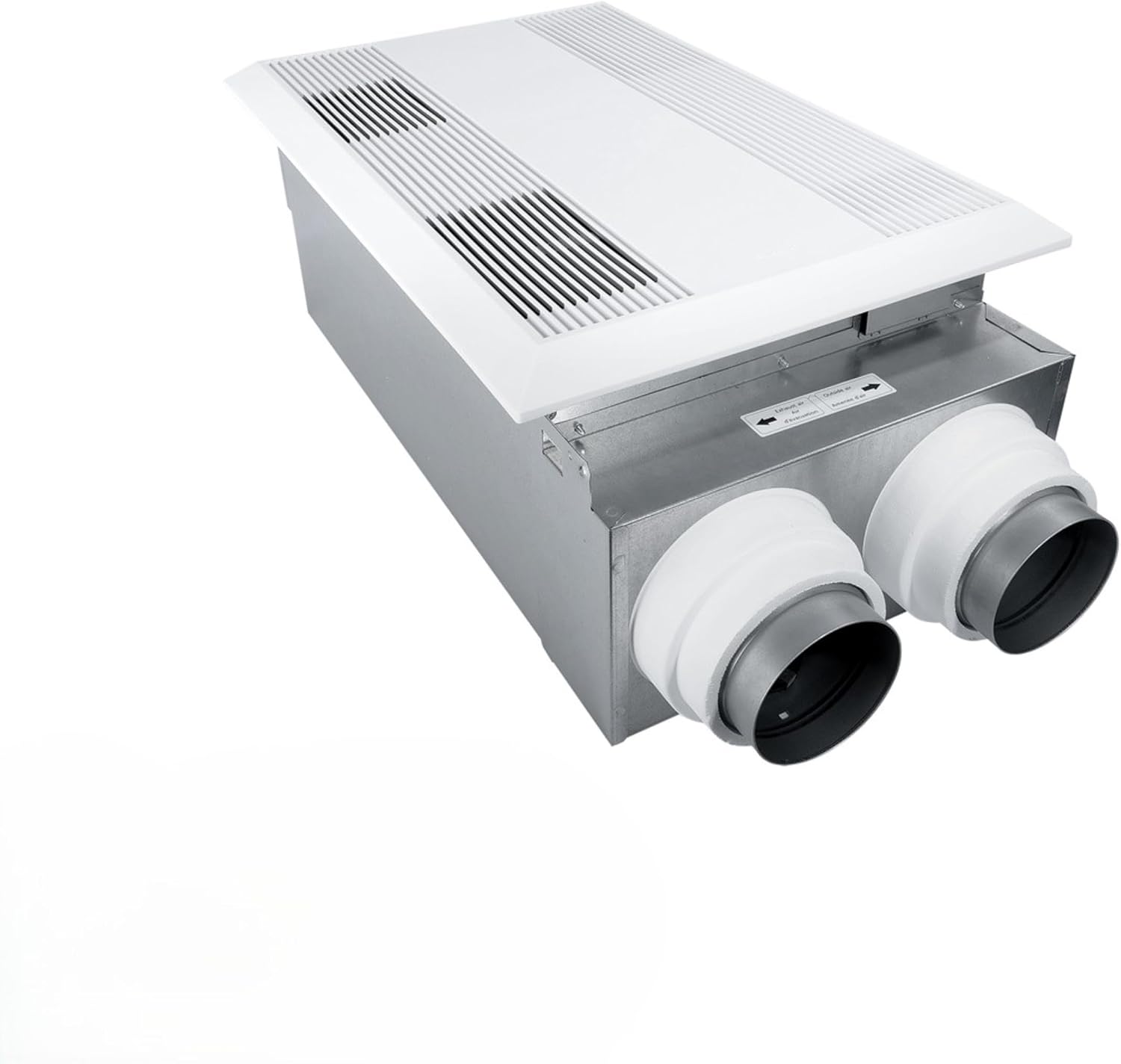
Panasonic FV-06VE1 WhisperComfort 60 ERV
This energy recovery ventilator is designed to provide tempered fresh air while balancing exhaust to maintain neutral home pressure. Its customizable airflow and flexible ceiling or wall mounting make it a versatile option for whole-house ventilation. It's a solid choice for those prioritizing indoor air quality and energy efficiency.
Pros
- Features energy recovery to temper incoming air and maintain humidity levels
- Offers customizable airflow with multi-speed selector and boost function up to 60 CFM
- Flexible installation options for ceiling or wall mounting
- Designed for easy airflow verification to meet ASHRAE compliance standards
- Relatively quiet operation at 2.5 sones
Cons
- Hardwired controller type limits installation flexibility compared to plug-in models
- Moderate user rating of 3.7 stars based on available feedback
Fantech VHR 150 HRV Unit
Designed for multi-bedroom homes, this heat recovery ventilator provides balanced, tempered fresh air year-round to improve indoor air quality. Its automatic defrost and compatibility with various controls make it a practical choice for energy-conscious homeowners.
Pros
- Features automatic defrost for reliable winter operation
- Washable electrostatic filters reduce maintenance costs
- Compatible with low-voltage and remote controls for flexible installation
- Suitable for higher static pressure applications in 2 to 5 bedroom homes
Cons
- A user rating of 3.5 stars suggests some operational or performance concerns
- Its substantial size and weight may require professional installation
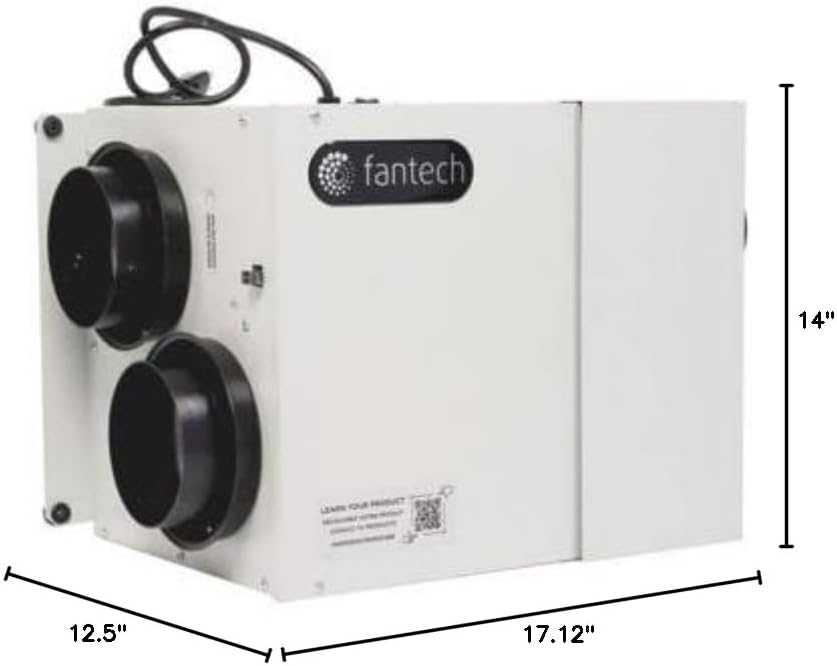
Fantech AEV80 Air Exchanger Ventilator with MERV8
This balanced ventilation unit continuously brings in fresh air while exhausting stale air, making it a solid choice for maintaining air quality in temperate climates. It's designed for homes with 1-2 bedrooms and offers flexible control with low, medium, and standby modes. The included washable MERV8 filter and compatibility with residential HVAC systems add to its practical appeal.
Pros
- Provides continuous balanced ventilation to improve indoor air quality
- Washable MERV8 synthetic filter is reusable
- Flexible three-speed operation (Low/Standby/Medium) for user control
- Compatible with standard residential HVAC systems for easier integration
- Can be installed in any physical orientation for versatile placement
Cons
- Designed for temperate climates, potentially less ideal for extreme weather
- Airflow capacity (82 cfm) is suitable for smaller 1-2 bedroom homes
Pioneer ERV150AHRPM25L Ductless Energy Recovery
This ductless ventilator tackles stale air in tightly sealed modern rooms by bringing in fresh, filtered air while recovering most of the energy. Its automatic 8-speed fan adjusts based on PM2.5 and CO2 sensors, and the multi-stage filtration targets particulates and odors. It's a fit for bedrooms or home offices up to 500 sq ft where installing ductwork isn't an option.
Pros
- Features a ductless design for single-room installation without major HVAC integration.
- Includes a 4-stage filtration system with HEPA and activated carbon for particulates and VOCs.
- Automatically adjusts ventilation based on built-in PM2.5 and CO2 sensors.
- Recovers up to 82% of energy from exhaust air to temper incoming fresh air.
- Offers multiple control options via app, touch screen, or remote with scheduling.
Cons
- Installation requires professional wall penetration, adding to upfront complexity and cost.
- The energy recovery efficiency, while high, is dependent on specific indoor/outdoor conditions.
Fantech VHR70R ES 70 CFM Heat Recovery Ventilator
This compact HRV from Fantech provides balanced ventilation with heat recovery, aiming to improve indoor air quality while managing energy use. It's built for year-round operation in cold climates with its recirculation defrost system and offers three-speed remote control. It's a consideration for those seeking a built-in, Energy Star qualified ventilation solution.
Pros
- Energy Star qualified for efficiency
- Compact size suitable for various installations
- Features recirculation defrost for cold-climate operation
- Remote control with three speed settings
- Provides balanced fresh air intake and stale air exhaust
Cons
- Relatively low air flow capacity of 70 CFM
- Heavy unit weight may complicate installation
- Button-based remote control may feel less modern
Pioneer ERV-50 Wall-Mounted Energy Recovery
This wall-mounted ventilator provides a compact, energy-efficient solution for refreshing indoor air. It stands out for its Wi-Fi-enabled controls, washable filters, and energy recovery system designed to maintain comfortable temperatures. It's a strong option for single-room applications where wall installation and quiet, continuous air exchange are priorities.
Pros
- Energy-efficient operation with heat recovery
- Wi-Fi control for remote access
- Washable and reusable filters
- Compact, wall-mounted design
- Super-silent operation
Cons
- Limited to single-room applications
- Requires professional in-wall installation
Fantech HERO 200H Heat Recovery Ventilator
This ventilator provides continuous fresh air exchange for a home while conserving energy. It's built around an efficient counterflow core that can recover up to 80% of heat from exhaust air, making it a solid choice for improving indoor air quality in a climate-controlled way.
Pros
- Provides up to 220 CFM of fresh, filtered air
- Energy-efficient counterflow core recovers up to 80% of heat
- Integrated MERV8 filter improves incoming air quality
- Top-mounted duct connections and front access simplify installation
Cons
- Plastic construction may not feel as durable as metal alternatives
- Lacks detailed user reviews for real-world performance validation
How We Picked
Our goal was to create an objective, data-driven list of the top Best hrv systems available in November 2026. We analyzed 10 models from leading manufacturers, comparing them on the following key criteria to determine which offer the best performance, efficiency, and value for different needs.
- Ventilation Capacity (CFM & Coverage): The unit’s ability to effectively exchange air for a given space size.
- Energy Recovery Efficiency: How well the system retains heating or cooling energy from exhaust air.
- Installation & Compatibility: Ease of integration with existing ductwork or suitability for wall-mounted, ductless applications.
- Operational Features & Controls: Including variable speeds, smart controls, defrost methods, and noise levels.
- Filter Quality & Maintenance: The type of filtration provided and how easy the system is to clean and service.
Buying Guide: Making Sense of Best Hrv Systems
Match the System to Your Space
The most critical step is sizing your ventilator correctly. A unit that’s too small won’t effectively refresh your air, while one that’s too large can be inefficient and costly. For whole-house systems, calculate based on your home’s total square footage and the required air changes per hour (ACH). For single-room solutions, consider the room’s volume. The Fantech Air Exchanger Ventilator 17-1/8″ L x is a good example of a unit sized for 1-2 bedroom homes, offering balanced ventilation for a specific area.
Understand HRV vs. ERV
Heat Recovery Ventilators (HRVs) and Energy Recovery Ventilators (ERVs) both exchange air, but they handle moisture differently. HRVs primarily transfer heat, making them ideal for cold, dry climates where you want to exhaust indoor humidity. ERVs transfer both heat and moisture, which is better for humid climates to help control indoor humidity levels. Choosing the right type for your local climate impacts both comfort and HVAC efficiency. Learn more about managing humidity with our guide on the best whole house dehumidifiers for crawl spaces.
Consider Installation and Daily Use
Think about how the unit will be installed and used daily. Ducted systems require professional HVAC integration, while ductless, wall-mounted units like the Pioneer ECOasis 150 Ductless Energy Recovery offer a simpler retrofit option. Also, evaluate operational noise—measured in decibels (dB)—especially for bedrooms or living areas, and look for user-friendly controls like multi-speed selectors or smart app connectivity.
Quick Checklist
- Have I calculated the correct CFM and coverage for my home or target room?
- Is an HRV or ERV more suitable for my local climate’s humidity levels?
- Does the unit’s mounting style (ducted, wall-mounted, ceiling) fit my installation capabilities?
- Are the operational noise levels and control features acceptable for daily use?
- What is the maintenance schedule and cost for filter replacement or cleaning?
Related reading: For solutions targeting specific airborne irritants, see the best air purifiers for allergies.
FAQs
What is the best hrv systems in 2026?
The “best” system depends entirely on your specific needs. For most whole-house applications requiring balanced, energy-efficient ventilation for a large space, the Aprilaire V22BEC ERV is a top contender. For a detailed comparison of all options, refer to our Quick Comparison table above.
How do I know what size HRV/ERV I need?
Size is based on airflow (CFM) and your home’s square footage. A common guideline is to provide 0.35 air changes per hour. For a 2,000 sq ft home with 8-foot ceilings, you’d need roughly 93 CFM. It’s best to consult with an HVAC professional or use manufacturer sizing guides. Our Heating & Cooling category has more resources on system sizing.
Can I install a ventilation system myself?
Ductless, wall-mounted units are often designed for DIY or handyman installation, involving cutting a hole in an exterior wall. However, ducted systems that integrate with your central HVAC almost always require professional installation to ensure proper balancing, sealing, and electrical connections.
How noisy are these systems?
Noise levels vary. Larger, whole-house units installed in basements or attics are often inaudible in living spaces. Wall-mounted room units, like the Broan B160H65RS AI 150 CFM Wall or Ceiling Mounted, are designed for quiet operation. Always check the product specifications for sound ratings in decibels (dB).
What maintenance is required?
Regular maintenance is crucial. This typically involves cleaning or replacing the air filters every 3-6 months and periodically cleaning the heat exchange core according to the manufacturer’s instructions to maintain efficiency and airflow.
Will an HRV/ERV help with allergies?
Yes, by continuously introducing filtered fresh air and exhausting stale indoor air, these systems can significantly reduce concentrations of indoor allergens like dust, pollen, and pet dander. For dedicated allergen removal, pair your ventilator with a high-quality air purifier. This guide covers the best combos for allergies and pet dander.
Final Thoughts
Investing in a quality ventilation system is an investment in your home’s health and comfort. For homeowners needing robust, whole-house fresh air for spaces up to 6,000 square feet, the Aprilaire V22BEC ERV stands out. If your project demands the highest airflow for challenging duct runs, the Fantech HERO 200H delivers the necessary power. And for those seeking a modern, app-controlled solution to refresh a single room efficiently, the Weiworld 6 Inch model with ceramic heat recovery is an excellent fit. When your system arrives, inspect it for any shipping damage, review the manual thoroughly, and ensure you have the recommended tools or professional help lined up for a smooth installation. For more information on creating a comprehensive home air quality strategy, visit our Cleaning Gear hub.
About the author
Editor, Humidifiers. Sofia writes about humidifiers. She compares cool mist and warm mist designs, tank capacity, coverage, noise and how easy each unit is to clean and refill.