Best Air Quality Monitors For Homes 2026: Reviews & Comparison
Concerned about your indoor air? The best air quality monitors for homes in 2026 combine accuracy with user-friendly features. We've compared 10 leading models from brands like Airthings, Aranet, Temtop and more to help you choose.
 By Hannah Brooks
Updated November 12, 2026
Poor indoor air quality can sneak up on you, leading to headaches, fatigue, and aggravated allergies. You might not see it, but pollutants like CO2, VOCs, and fine particles can accumulate, especially in well-sealed modern homes. The right air quality monitor takes the guesswork out, showing you exactly what’s in your air so you can act. For most people, choosing a monitor boils down to which pollutants it detects, how it connects and displays data, and its ease of use for daily life.

Our analysis of the top models available in November 2026 points to the Aranet4 Indoor Air Quality Monitor as the best overall choice for its precision and long battery life. For those specifically concerned about the serious health risks of radon gas, the Airthings 2960 View is a comprehensive, smart monitor that provides continuous peace of mind. Understanding your air is the first step to improving it, a topic we also cover in our guide on the best hepa air purifiers.
The 3 Best Air Quality Monitors For Homes on Our Shortlist (November 2026)
- Best for: Comprehensive CO2 and environmental monitoring
- Sensors: CO2, Temp, Humidity, Pressure
- Connectivity: Bluetooth & App
- Battery Life: Up to 4 years

- Best for: Whole-home radon and multi-pollutant tracking
- Sensors: Radon, PM2.5, CO2, VOC, Temp, Humidity, Pressure
- Connectivity: Wi-Fi & App
- Display: Customizable eInk

- Best for: Simple PM2.5 and comfort monitoring
- Sensors: PM2.5, Temp, Humidity
- Battery Life: Up to 60 days
- Portability: Compact and lightweight
This post may contain affiliate links. As an Amazon Associate we earn from qualifying purchases.
Quick Comparison
| Award | Product | APT Score About LAT ScoreThe APT Score is our own rating from 0 to 10, based on performance, design and build, ease of use, and value. It reflects independent research and is never influenced by manufacturers, retailers, or affiliate commissions. Learn more › | Price | |
|---|---|---|---|---|
| Best Overall |
Aranet4 Wireless Indoor Air Quality Monitor
|
8.9/10 | $189.00 | Buy |
| Best Premium |
 Airthings Corentium Home 223 Radon Detector |
8.8/10 | $146.15 | Buy |
| Also Great |
Airthings 2960 View Plus Air Quality Monitor
|
7.8/10 | $329.99 | Buy |
| Most Popular |
 Amazon Smart Air Quality Monitor |
8.1/10 | $69.99 | Buy |
| Also Great |
 Temtop LKC-1000S+ Air Quality Monitor |
8.1/10 | $135.99 | Buy |
| Top Rated |
 GoveeLife H5106 Smart Air Quality Monitor |
8.3/10 | $39.98 | Buy |
| Best Budget |
 Temtop C1-JP CO2 Monitor with Temperature |
8.4/10 | $32.99 | Buy |
| Also Great |
 BREATHETECH Airmonitor Plus Gen 2 8-in-1 Air |
7.8/10 | $129.99 | Buy |
| Best Value |
 Airthings Wave Radon Smart Detector |
8.4/10 | $109.15 | Buy |
| Also Great |
Temtop S1 PM2.5 and AQI Monitor
|
8.0/10 | $27.99 | Buy |
Aranet4 Wireless Indoor Air Quality Monitor
This premium air quality meter focuses on precise CO2 detection, along with temperature, humidity, and pressure. Its standout feature is a cable-free design with an e-ink display and a multi-year battery life, making it a convenient, low-maintenance choice for continuous monitoring. The intuitive color-coded display and companion app for data history simplify interpreting readings for healthier indoor spaces.
Pros
- Extremely long battery life (up to 4 years) with a cable-free, e-ink display.
- Measures multiple parameters: CO2, temperature, humidity, and atmospheric pressure.
- Intuitive display with color coding and a prominent CO2 number for easy reading.
- Includes a free app for viewing and analyzing up to 90 days of historical data.
- Uses precise NDIR sensor technology and is manufactured in the EU.
Cons
- Requires AA batteries (included), which are not rechargeable.
- The display is monochrome e-ink, not a full-color screen.
Airthings Corentium Home 223 Radon Detector
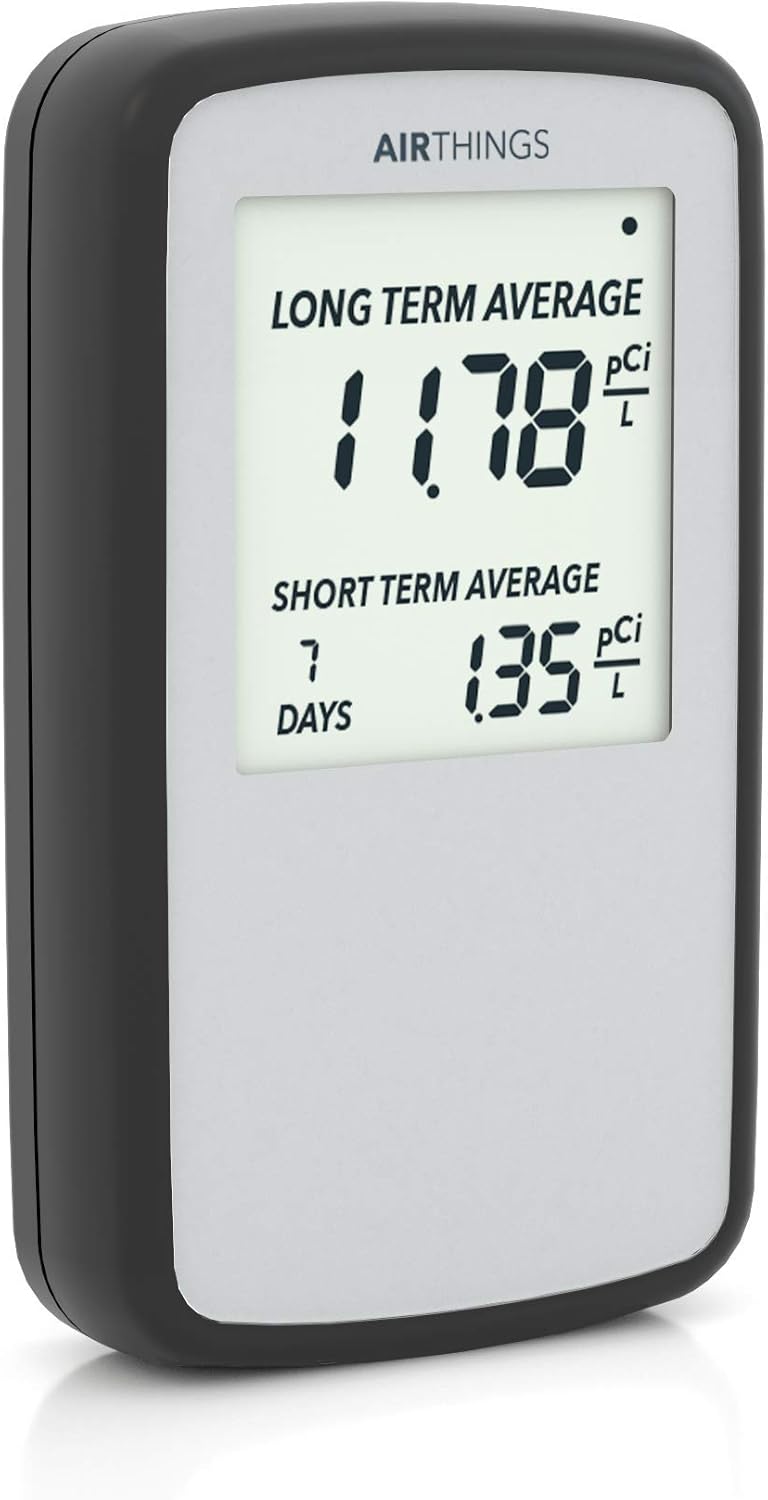
This portable radon detector provides long-term monitoring of a critical, invisible health hazard. Its battery-powered, lightweight design makes it simple to move between rooms for comprehensive home assessment.
Pros
- First battery-operated digital radon detector for cordless placement.
- Provides both short-term and long-term average readings on an LCD screen.
- No annual calibration required, with an estimated lifespan of over 10 years.
- Portable and lightweight for easy multi-room measurement.
Cons
- Requires 3 AAA batteries for operation.
Airthings 2960 View Plus Air Quality Monitor
This comprehensive air quality monitor provides an always-on, multi-sensor assessment of your indoor environment, including radon, a leading cause of lung cancer. It's ideal for homeowners seeking detailed, long-term data on pollutants and environmental factors.
Pros
- Comprehensive monitoring of seven air quality parameters, including radon, PM2.5, CO2, and VOCs
- Battery-powered and cable-free for flexible placement
- WiFi-connected with a free app for remote monitoring and trend analysis
- Offers a five-year extended warranty upon registration
Cons
- Requires the Airthings app and an account (email and name) to function
- Device and app both require internet access for full functionality
Amazon Smart Air Quality Monitor
This smart monitor provides a clear, color-coded overview of your indoor air, tracking PM2.5, VOCs, carbon monoxide, humidity, and temperature. Its deep integration with Alexa allows for automated routines with other smart devices and instant notifications.
Pros
- Monitors five key air quality factors
- Provides clear visual and app-based air quality scores
- Deep Alexa integration enables smart home automations
Cons
- Requires an Alexa ecosystem for full functionality
Temtop LKC-1000S+ Air Quality Monitor
This semi-professional 7-in-1 monitor tracks a comprehensive set of indoor pollutants and conditions, including PM2.5, formaldehyde, and TVOC. Its key strengths are professional-grade data logging and a detailed trend histogram, making it suitable for long-term health tracking or verifying the effectiveness of air purifiers and ventilation.
Pros
- Measures seven key parameters (PM2.5, PM10, HCHO, TVOC, humidity, temperature, AQI)
- Features a high-accuracy electrochemical formaldehyde sensor, not a basic semiconductor type
- Exports logged data to Excel via USB for professional analysis over three months
- Includes a 12-hour trend histogram to identify pollution sources
- Functions as both a portable spot-check device and a plug-in continuous monitor
Cons
- Does not detect hazardous gases like carbon monoxide
- Requires a 10-minute warm-up period after moving between extreme temperatures for stable readings
GoveeLife H5106 Smart Air Quality Monitor
This wired monitor provides detailed, real-time tracking of PM2.5, temperature, and humidity, with data refreshing every two seconds. It's a strong choice for users with other GoveeHome appliances, as it can trigger them automatically based on air quality changes.
Pros
- Fast, two-second data refresh rate for real-time monitoring
- Integrates with GoveeHome appliances for automated climate control
- Offers long-term data storage and export via the app
- Features a clear LED display with switchable modes
Cons
- Requires a constant power connection and has no battery
- Needs a 2.4G Wi-Fi network to display the clock function
- PM2.5 accuracy has a ±15 µg/m³ margin in lower ranges
Temtop C1-JP CO2 Monitor with Temperature
This portable monitor offers a Swiss-engineered photoacoustic sensor for precise CO2 readings, plus temperature and humidity tracking. Its 70-day battery life and customizable alerts make it a practical, low-maintenance choice for monitoring air quality in offices, schools, or bedrooms.
Pros
- Accurate CO2 monitoring (±40 ppm) with a high-end Swiss Sensirion sensor and 5-second refresh rate.
- Multifunctional design that also tracks indoor temperature and humidity.
- Long 70-day battery life on standby, promoting efficiency and minimal upkeep.
- Portable and versatile with a slim design and multiple mounting options.
- Customizable settings allow users to disable audio and display lights for undisturbed sleep.
Cons
- Cannot detect carbon monoxide (CO), which is a separate air quality concern.
- Requires being plugged in for real-time monitoring mode, limiting true portability during continuous use.
BREATHETECH Airmonitor Plus Gen 2 8-in-1 Air
This monitor provides comprehensive, real-time tracking of eight key air quality parameters, including CO2, particulate matter, and VOCs. Its smart app integration and data export capabilities make it a versatile tool for data-driven users aiming to improve their indoor environment.
Pros
- True NDIR CO2 sensor for accurate, direct measurement
- Comprehensive 8-in-1 monitoring including PM1/2.5/10, TVOC, and formaldehyde
- Smart app with alerts, trend graphs, and 90-day data history with CSV export
- Portable design with up to 6 hours of battery life for on-the-go use
Cons
- Requires 2.4 GHz Wi-Fi, not compatible with 5 GHz networks
- Does not detect carbon monoxide (CO), gas leaks, or smoke
Airthings Wave Radon Smart Detector
This smart detector provides continuous, long-term radon monitoring without lab fees, sending detailed data directly to your phone. It also tracks humidity and temperature, and a simple wave of the hand gives a color-coded air quality status.
Pros
- Provides continuous, long-term radon monitoring directly to smartphone via app
- No lab fees required for results
- Simple, battery-powered installation without cords
- Includes color-coded visual indicator for quick status checks
- Also monitors humidity and temperature
Cons
- Requires Bluetooth range or an Airthings Hub for continuous data sync
- Premium price point for a dedicated radon detector
Temtop S1 PM2.5 and AQI Monitor
This compact monitor provides a clear, consolidated readout of both environmental comfort and air quality. Its dual focus on PM2.5/AQI alongside precise temperature and humidity tracking makes it a practical tool for health-conscious households, offices, or schools. The standout 60-day battery life enhances its utility as a portable device for monitoring multiple rooms.
Pros
- Combines PM2.5/AQI monitoring with precise temperature and humidity sensing in one device.
- Long 60-day battery life on a single charge supports portable, multi-room use.
- Compact and portable design with a clear, at-a-glance display.
Cons
- Temperature measurement range (10°C to 50°C) may not cover all extreme indoor environments.
How We Picked
To build this list, we analyzed 10 of the most popular and highly-rated air quality monitors. Our goal was to provide a transparent, objective comparison to help you make an informed decision. We focused on key metrics and user feedback to evaluate each model’s strengths for different needs.
- Sensor Accuracy & Type: We prioritized monitors with proven sensor technologies (like NDIR for CO2) known for reliable, long-term accuracy over estimates.
- Pollutants Monitored: The list reflects a range from specialized detectors (like radon) to multi-parameter units tracking PM2.5, VOCs, CO2, and environmental factors.
- Data Accessibility: We considered how you access the data—via onboard display, smartphone app, or historical exports—and the clarity of the information presented.
- Ease of Use & Setup: Products were evaluated on their plug-and-play readiness, placement flexibility (battery vs. wired), and overall user-friendliness.
- Value & Purpose: Each pick was assessed for how well it delivers on its core promise, whether that’s premium whole-home monitoring or simple, portable spot-checking.
Buying Guide: Making Sense of Best Air Quality Monitors For Homes
Know What You’re Measuring
The first decision is what you want to track. For general air quality and ventilation insight, CO2 is a key indicator. For allergy or asthma sufferers, a monitor with a laser particle sensor for PM2.5 is essential. In areas with known risks, a dedicated radon detector like the Airthings 2950 Wave Radon is a critical investment. If you’re concerned about chemicals from cleaning, paints, or new furniture, look for TVOC and formaldehyde sensors.
Connectivity and Data Logging
Consider how you prefer to view your data. A simple color-coded LED or e-ink display gives an at-a-glance status. Smartphone apps, like those used by the Amazon Smart Air Quality Monitor – Know your air, offer detailed graphs, historical trends, and remote alerts. For professional use or health tracking, the ability to export data to a spreadsheet is a valuable feature. Smart integration can also automate other devices; for instance, a monitor can trigger a connected air purifier or dehumidifier when levels rise.
Placement and Power
Think about where you’ll place your monitor. Battery-powered models offer ultimate flexibility for moving between rooms or placing away from outlets. Wired models ensure constant power for continuous, real-time monitoring without battery changes. Placement matters too—keep monitors away from direct airflow from vents, windows, or appliances for the most accurate room-level reading. For whole-home assessment, you might need more than one unit, a strategy often paired with using effective air purifiers for allergies in key rooms.
Quick Checklist
- Identify your primary air quality concerns (e.g., radon, allergens, ventilation).
- Verify the sensor technology matches your need for accuracy.
- Choose a data display method (on-device, app) that fits your lifestyle.
- Ensure the power source (battery, plug-in) works for your intended location.
- Check for any smart home integrations you plan to use.
Related reading: Learn how to manage moisture levels with our guide to the best whole-house dehumidifiers for crawl spaces.
FAQs
What is the best air quality monitors for homes in 2026?
The “best” depends on your specific needs. For most homes wanting to optimize ventilation and monitor core environmental factors, a precise CO2 monitor like our top pick is ideal. For radon detection, a dedicated monitor from a trusted brand is non-negotiable.
Where should I place an air quality monitor?
Place it in the room where you spend the most time, like a bedroom or living room, at breathing height (about 3-5 feet off the floor). Avoid placing it directly next to windows, doors, air vents, or appliances that emit heat or fumes, as this will skew the readings.
Do I need a smart app for my air quality monitor?
Not necessarily. An onboard display is sufficient for instant readings. However, a smart app provides valuable historical data, trend analysis, and remote alerts, which are crucial for understanding long-term patterns, especially for pollutants like radon that fluctuate. Many models, including those from the air purifiers category, offer this connectivity.
How often do the sensors need calibration or replacement?
It varies by sensor type and model. High-quality NDIR CO2 sensors and electrochemical sensors for radon/VOCs are designed for long-term stability, often lasting for years. Particle sensors may require occasional cleaning. Always check the manufacturer’s specifications for expected sensor lifespan and calibration requirements.
Can an air quality monitor help with my allergies?
Yes, indirectly. A monitor that tracks PM2.5 can alert you to high levels of fine allergens like dust, pollen, and pet dander. This data allows you to take action, such as running an air purifier, increasing ventilation, or cleaning, before your symptoms flare up. For a direct solution, explore air purifiers for allergies and pet dander.
What’s the difference between a CO2 monitor and a carbon monoxide (CO) detector?
They measure different gases. CO2 (carbon dioxide) is a natural part of the air we exhale; high indoor levels indicate poor ventilation and can cause drowsiness. CO (carbon monoxide) is a poisonous, odorless gas from faulty combustion appliances. You need a UL-listed CO alarm for life safety. Some advanced air quality monitors, like the Amazon model, include a CO sensor, but it does not replace a dedicated CO alarm required by building codes.
Final Thoughts
Choosing the right monitor empowers you to take control of your indoor environment. The Aranet4 Indoor Air Quality Monitor stands out for users who need reliable, long-term data on CO2 and basic environmental factors to guide ventilation habits. The Airthings 2960 View is the definitive choice for homeowners who require comprehensive, continuous monitoring of radon alongside other key pollutants. For those on a budget or who simply want to keep an eye on particulate matter and room comfort, the Temtop S1 PM2.5 Air Quality Monitor & Indoor offers excellent value and simplicity. Once your monitor arrives, give it time to acclimatize in its location, review the manual for any initial setup steps, and use the data it provides to make informed changes—whether that’s opening a window, using an air purifier, or investigating a potential source of pollution. For more ways to create a healthier home, consider how proper heating and cooling systems also contribute to air circulation and quality.
About the author
Managing Editor & Buying Guides. Hannah oversees the editorial calendar and edits every buying guide. She makes sure each guide states its criteria up front, shows pros and cons side by side, and says who a product is not for.