The 9 Best Air Quality Monitors For Mold of 2026
Mold spores in your home's air can cause significant health issues. These air quality monitors detect airborne mold particles to help you identify and address the problem.
 By Amara Okafor
Updated November 12, 2026
Mold spores in your home can trigger allergies, aggravate asthma, and cause persistent musty odors. When you suspect poor air quality, you need a device that can detect the specific pollutants that indicate mold growth, such as elevated humidity, VOCs from microbial activity, and fine particulate matter. The right monitor will be accurate, easy to interpret, and ideally integrate with other smart home devices to automate a healthier environment.

After analyzing the market, we recommend the GoveeLife Smart Air Quality Monitor with PM2.5 for most users due to its balance of essential metrics, smart connectivity, and value. For those needing the most comprehensive detection, including radon, the Airthings 2960 View is a premium choice. Understanding how these devices work can help you make an informed decision, as detailed in our guide to air purifiers for allergies.
The 3 Best Air Quality Monitors For Mold on Our Shortlist (November 2026)
- Best for: Smart home integration
- Monitors: PM2.5, Temp, Humidity
- Connectivity: Wi-Fi & Bluetooth
- Display: LED with color-coded air quality

- Best for: Comprehensive health monitoring
- Monitors: Radon, PM2.5, CO2, VOCs
- Connectivity: Wi-Fi
- Power: Battery-operated

- Best for: Multi-room portability
- Monitors: 9 key parameters
- Battery: 10-hour cordless life
- Alerts: 7 distinct AQI buzzers
This post may contain affiliate links. As an Amazon Associate we earn from qualifying purchases.
Quick Comparison
| Award | Product | APT Score About LAT ScoreThe APT Score is our own rating from 0 to 10, based on performance, design and build, ease of use, and value. It reflects independent research and is never influenced by manufacturers, retailers, or affiliate commissions. Learn more › | Price | |
|---|---|---|---|---|
| Best Overall |
GoveeLife H5106 Smart Air Quality Monitor
|
8.3/10 | $39.98 | Buy |
| Best Premium |
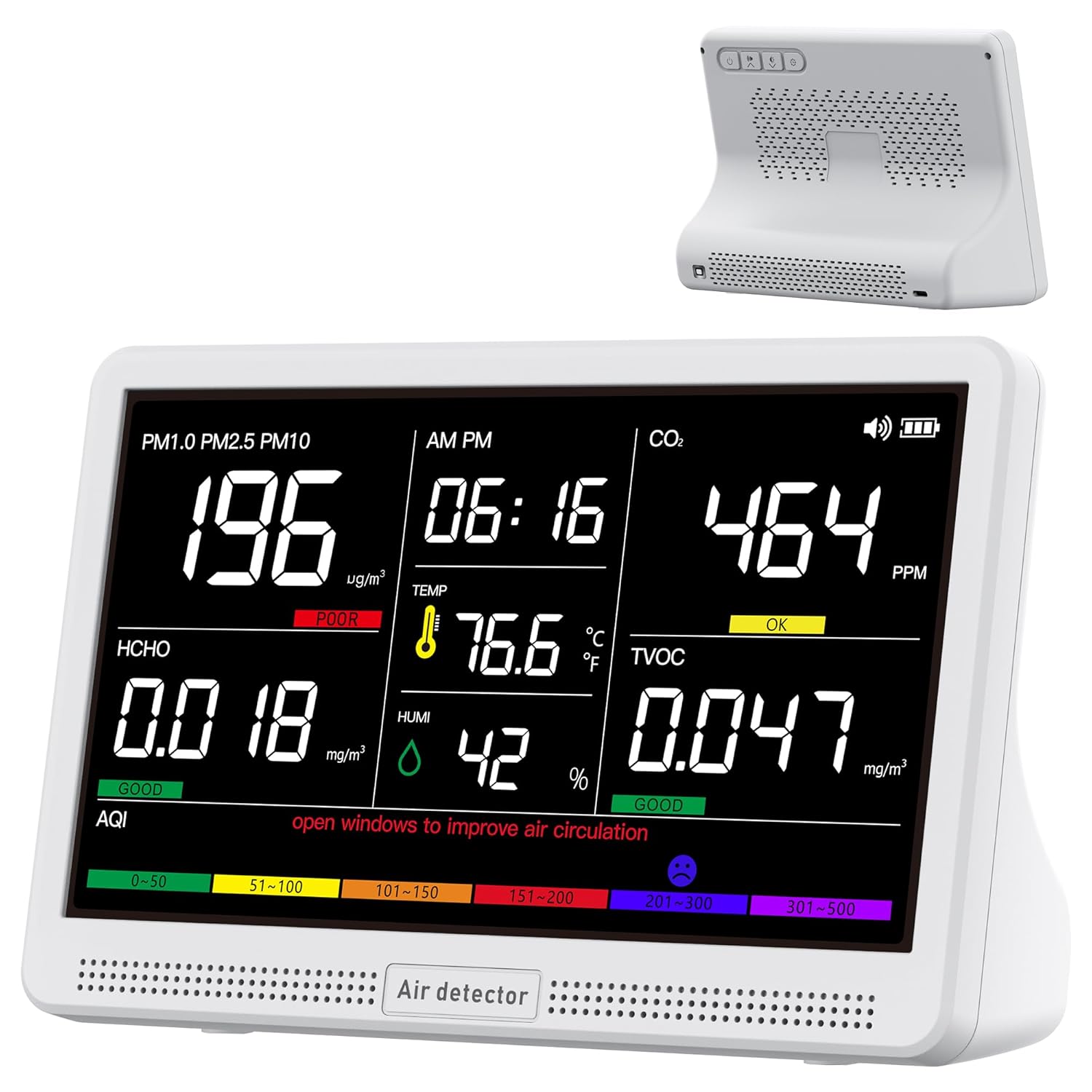 Bonoch AK22A Air Quality Monitor with 16-in-1 |
8.3/10 | $119.99 | Buy |
| Best Value |
 Amazon Smart Air Quality Monitor |
8.1/10 | $69.99 | Buy |
| Top Rated |
 YNAK AK22A 7 inch Air Quality Monitor |
8.1/10 | $89.99 | Buy |
| Also Great |
 LifeBasis 11-in-1 Indoor Air Quality Monitor |
7.8/10 | $61.79 | Buy |
| Also Great |
 BREATHETECH Airmonitor Plus Gen 2 8-in-1 Air |
7.8/10 | $129.99 | Buy |
| Most Popular |
Airthings 2960 View Plus Air Quality Monitor
|
7.8/10 | $329.99 | Buy |
| Best Budget |
YNAK ABCABCABC11111 16-in-1 Air Quality Monitor
|
7.6/10 | $35.08 | Buy |
| Also Great |
 ZYKYCX ZY-HC4000 Formaldehyde and Air Quality |
6.5/10 | $59.99 | Buy |
GoveeLife H5106 Smart Air Quality Monitor
This wired monitor provides detailed, real-time tracking of PM2.5, temperature, and humidity, with data refreshing every two seconds. It's a strong choice for users with other GoveeHome appliances, as it can trigger them automatically based on air quality changes.
Pros
- Fast, two-second data refresh rate for real-time monitoring
- Integrates with GoveeHome appliances for automated climate control
- Offers long-term data storage and export via the app
- Features a clear LED display with switchable modes
Cons
- Requires a constant power connection and has no battery
- Needs a 2.4G Wi-Fi network to display the clock function
- PM2.5 accuracy has a ±15 µg/m³ margin in lower ranges
Bonoch AK22A Air Quality Monitor with 16-in-1
This indoor air quality monitor from Bonoch provides a comprehensive overview of your environment by tracking 16 different parameters, including CO2 and AQI. Its 6-hour battery life offers flexibility for monitoring different rooms, and it includes alerts for key pollutants. It's a solid choice for homeowners seeking detailed, multi-parameter air quality feedback.
Pros
- Comprehensive 16-in-1 air quality detection
- Includes CO2 monitoring and AQI alerts
- 6-hour battery life for portable use
- Comes with required D battery
Cons
- Relies on a single D battery, which may require frequent replacement for continuous use
- Manufacturer and model details suggest it may be a generic or rebranded device
Amazon Smart Air Quality Monitor
This smart monitor provides a clear, color-coded overview of your indoor air, tracking PM2.5, VOCs, carbon monoxide, humidity, and temperature. Its deep integration with Alexa allows for automated routines with other smart devices and instant notifications.
Pros
- Monitors five key air quality factors
- Provides clear visual and app-based air quality scores
- Deep Alexa integration enables smart home automations
Cons
- Requires an Alexa ecosystem for full functionality
YNAK AK22A 7 inch Air Quality Monitor
This YNAK monitor brings CO2, particulates, VOCs, formaldehyde, temperature, humidity, and AQI onto one 7 inch display. Based on the listed features, it fits homes or offices that want a simple standalone screen with audible alerts. The battery and USB C charging add flexibility for bedrooms, vehicles, or moving between rooms.
Pros
- Tracks 9 common indoor air parameters, including CO2, PM2.5, PM10, PM1.0, HCHO, TVOC, temperature, humidity, and AQI.
- The large 7 inch display with three brightness settings makes readings easy to see without menu navigation.
- Seven AQI alert buzzers and a mute button provide audible warnings while allowing quiet operation when needed.
- Up to 8 hours of runtime plus USB C charging and an included AC adapter support flexible placement.
- The package includes a 12 month warranty and customer support, which can help with setup or unit issues.
Cons
- The 16 in 1 label counts 7 alert buzzer types alongside 9 measured parameters, not 16 separate sensors.
- External sensors require careful placement and protection from perfumes or strong odors to preserve accuracy.
- Up to 8 hours of battery life may require frequent charging or power access for continuous monitoring.
LifeBasis 11-in-1 Indoor Air Quality Monitor
This comprehensive monitor tracks 11 key air quality metrics, including particulate matter, CO2, VOCs, and humidity, offering a detailed snapshot of your indoor environment. It stands out with its visual and audible dual-alert system, which provides immediate feedback on air quality changes. Its portable design and long battery life make it suitable for checking air quality in different rooms or locations.
Pros
- Monitors a wide range of 11 air quality parameters
- Features a clear dual-alert system with color-coded indicators and sound
- Portable with a long-lasting battery for continuous use
- Equipped with high-precision NDIR and laser sensors for accurate readings
- Easy-to-read LCD screen with adjustable brightness
Cons
- Battery life of 11-12 hours may require frequent charging for all-day use
BREATHETECH Airmonitor Plus Gen 2 8-in-1 Air
This monitor provides comprehensive, real-time tracking of eight key air quality parameters, including CO2, particulate matter, and VOCs. Its smart app integration and data export capabilities make it a versatile tool for data-driven users aiming to improve their indoor environment.
Pros
- True NDIR CO2 sensor for accurate, direct measurement
- Comprehensive 8-in-1 monitoring including PM1/2.5/10, TVOC, and formaldehyde
- Smart app with alerts, trend graphs, and 90-day data history with CSV export
- Portable design with up to 6 hours of battery life for on-the-go use
Cons
- Requires 2.4 GHz Wi-Fi, not compatible with 5 GHz networks
- Does not detect carbon monoxide (CO), gas leaks, or smoke
Airthings 2960 View Plus Air Quality Monitor
This comprehensive air quality monitor provides an always-on, multi-sensor assessment of your indoor environment, including radon, a leading cause of lung cancer. It's ideal for homeowners seeking detailed, long-term data on pollutants and environmental factors.
Pros
- Comprehensive monitoring of seven air quality parameters, including radon, PM2.5, CO2, and VOCs
- Battery-powered and cable-free for flexible placement
- WiFi-connected with a free app for remote monitoring and trend analysis
- Offers a five-year extended warranty upon registration
Cons
- Requires the Airthings app and an account (email and name) to function
- Device and app both require internet access for full functionality
YNAK ABCABCABC11111 16-in-1 Air Quality Monitor
This monitor assesses nine critical air parameters, including CO2, particulate matter, and VOCs, using external sensors for direct sampling. Its comprehensive alerts and long battery life make it suitable for those seeking detailed, portable air quality data. The large display provides clear readings at a glance.
Pros
- Monitors a wide array of nine key air quality parameters
- Features external sensors with a claimed high precision of 0.001 units
- Offers up to 10 hours of cordless operation for portability
- Provides seven distinct AQI alerts with a mute function
- Includes a large 5.5-inch display for easy readability
Cons
- Sensors require careful handling to avoid contamination from strong odors
ZYKYCX ZY-HC4000 Formaldehyde and Air Quality
A multi-functional air quality monitor focused on formaldehyde detection, featuring a 2.8-inch LCD and three distinct alarm types. It suits users seeking a portable, rechargeable device for spot-checking HCHO, temperature, and humidity in various indoor environments.
Pros
- Offers three simultaneous alarm types: audible (95dB), visual LED, and vibration.
- Functions as a multi-parameter meter, displaying real-time formaldehyde, temperature, and humidity.
- Portable design with a 16-hour battery life and carrying accessories like a bag and clip.
Cons
- With a 3.2-star average from 35 reviews, user satisfaction appears mixed.
- Its industrial style and 14.4-ounce weight may feel bulky for some home users.
How We Picked
Our selection for November 2026 was based on a detailed analysis of specifications, user ratings, and feature sets relevant to detecting conditions favorable for mold. We prioritized objectivity by comparing products across consistent criteria. The goal was to identify devices that provide actionable data for maintaining a healthy indoor environment.
- Key Parameters Monitored: We focused on devices that track humidity, PM2.5, and VOCs, as these are primary indicators of potential mold issues.
- Accuracy & Sensor Quality: Products with documented sensor precision and technology (e.g., NDIR for CO2, laser for particles) were weighted more heavily.
- Usability & Alerts: Clear displays, intuitive apps, and customizable alert systems were essential for practical, day-to-day use.
- Connectivity & Data: We considered smart features like Wi-Fi/Bluetooth for remote monitoring and data history, which help track trends over time.
- Power & Placement Flexibility: Options for both plugged-in and portable, battery-powered operation were evaluated to suit different room setups.
Buying Guide: Making Sense of Best Air Quality Monitors For Mold
Focus on the Right Metrics
Not all air quality monitors are equally useful for mold detection. The most critical metrics are relative humidity (aim to keep it below 60% to discourage growth), PM2.5 (which can carry mold spores), and VOCs (which can be emitted by active mold colonies). While a device like the 16 in 1 Air Quality Monitor Indoor 7″ offers a wide array of sensors, ensure the ones relevant to mold are included and accurate. For a deeper dive into managing airborne allergens, see our review of the best air purifiers for allergies and pet dander.
Consider Your Home’s Layout and Needs
Think about where you need monitoring. A single, stationary unit is fine for a consistent problem area like a basement. For checking multiple rooms or identifying sources, a portable device with a good battery life is key. Also, consider if you want the monitor to trigger other devices automatically; smart models can be linked to dehumidifiers or air purifiers to react when conditions worsen.
The LifeBasis Air Quality Monitor Indoor, for example, offers portability with an 11-12 hour battery, making it easy to move between a bedroom, living room, and basement to compare readings.
Ease of Use and Data Accessibility
A monitor is only helpful if you understand its data. Look for devices with clear, at-a-glance displays using color-coded indicators (e.g., green for good, red for poor). Smartphone apps that provide historical graphs are invaluable for spotting trends, like a gradual rise in humidity over several days, which might not be obvious from a single reading.
Quick Checklist
- Does it measure humidity, PM2.5, and VOCs with reliable sensors?
- Is the display easy to read and interpret quickly?
- Does it offer audible or visual alerts for unsafe levels?
- Does its power source (plug-in vs. battery) fit your intended placement?
- If needed, does it connect to an app for remote monitoring and data history?
Related reading: For those also concerned about eliminating odors often associated with dampness, explore the best air purifiers for smells.
FAQs
What is the best air quality monitors for mold in 2026?
The “best” depends on your specific needs. For most people seeking a balance of core mold-related metrics, smart features, and affordability, our top overall pick is a strong choice. For the most thorough health-focused monitoring, including radon, a premium model is worth the investment.
How do I know if my monitor is accurate?
Look for products that specify sensor accuracy (e.g., ±3% for humidity) and use recognized sensor technologies like NDIR for CO2. While consumer-grade devices may not be lab-perfect, consistency in tracking trends is more important than an absolute pinpoint reading. Avoid placing sensors near direct airflow, windows, or chemical sources.
Can these monitors connect to my other smart home devices?
Some can. Monitors with Wi-Fi and compatibility with platforms like Alexa or specific brand ecosystems (like GoveeHome) can trigger routines. For instance, they can turn on a smart dehumidifier when humidity rises. Check the product’s specifications for supported integrations. Our guide to whole-house fans discusses another way to improve air circulation.
Do I need a monitor that detects formaldehyde specifically?
Formaldehyde is a specific VOC often associated with new building materials and furniture, not directly with mold. However, a general VOC sensor will alert you to a broad range of chemical pollutants, which can include emissions from mold. A dedicated Formaldehyde Detector, Rechargeable HCHO Monitor is best if that single chemical is your primary concern.
Where should I place the monitor in my room?
Place it in the breathing zone, about 3-5 feet off the ground, away from doors, windows, vents, or any direct source of moisture or chemicals (like a kitchen stove or cleaning cabinet). This gives a representative sample of the air you actually breathe.
What maintenance do these devices require?
Most require minimal maintenance. Keep the sensor inlets free of dust and debris. Avoid exposing sensors to perfumes, aerosols, or smoke directly, as this can temporarily skew readings or damage sensitive components. Refer to the manual for any specific calibration advice. For maintaining clean air in the first place, consider a quality faucet water filter as part of a holistic healthy home approach.
Final Thoughts
Selecting the right tool comes down to matching the device to your priorities. The GoveeLife model excels for users who want smart, connected monitoring of the core metrics (PM2.5, temperature, humidity) at an accessible price point. The Airthings 2960 View is the definitive choice for comprehensive health monitoring, offering peace of mind with its radon detection and multi-sensor array. For those needing to move a monitor between several rooms to pinpoint issues, the portable 16-in-1 monitor from YNAK provides extensive data on a cordless device. Ultimately, the best monitor is the one you will use consistently to gain insights and take action. For more information on creating a healthier home environment, explore our guide to travel humidifiers. When your new monitor arrives, place it in a central location, connect it to its app if available, and let it gather baseline data for at least 24-48 hours before drawing conclusions.
About the author
Contributor, Smart Home & Appliance Tech. Amara covers smart features in home appliances, including app control, sensors, voice assistants and automation, and notes when a feature adds real value and when it is a gimmick.