Best Radon Fans For Basements for November 2026
Best radon fans for basements for your basement. Our November 2026 guide compares 8 top-rated models from RadonAway, Suncourt, Tjernlund and more, priced from $75.95 to $259.58.
 By Grace Lindqvist
Updated November 12, 2026
Discovering elevated radon levels in your basement can be unsettling, raising immediate concerns about long-term health risks and the safety of your living environment. The right radon mitigation fan is crucial for peace of mind, but choosing one involves navigating technical specs like CFM (cubic feet per minute), compatibility with your existing ductwork, and the balance between powerful suction and quiet operation. The key decisions center on ensuring the fan has sufficient power for your home’s size, fits your 4-inch or 4.5-inch PVC system, and operates quietly enough for its intended location, whether indoors or out.

After reviewing 8 models, we find the Festa AMG Maverick Radon Fan to be an excellent all-around choice for most homeowners due to its strong 260 CFM airflow and energy-efficient, quiet operation. For those seeking a straightforward, reliable kit that includes essential installation components, the 4 inch Radon Fan Installation Kit is a standout option. For more on managing indoor air quality, explore our related guide on the best whole house dehumidifiers for crawl spaces.
The 3 Best Radon Fans For Basements on Our Shortlist (November 2026)
- Best for: Balanced performance and quiet operation
- Airflow: 260 CFM
- Noise Level: 50-60 dB
- Warranty: 5-year

- Best for: Proven reliability and ultra-quiet use
- Airflow: 145 CFM
- Noise Level: Ultra-quiet
- Inlet/Outlet: 4.5 inch

- Best for: Budget-friendly waterproof protection
- Airflow: 190 CFM
- Waterproof Rating: IP67
- Warranty: 8-year limited
This post may contain affiliate links. As an Amazon Associate we earn from qualifying purchases.
Quick Comparison
| Award | Product | APT Score About LAT ScoreThe APT Score is our own rating from 0 to 10, based on performance, design and build, ease of use, and value. It reflects independent research and is never influenced by manufacturers, retailers, or affiliate commissions. Learn more › | Price | |
|---|---|---|---|---|
| Best Overall |
Festa AMG Maverick 4-Inch Radon Mitigation Fan
|
8.8/10 | $147.00 | Buy |
| Best Premium |
 MIDCVFRUN Radon Fan Kit 260CFM 2-Speed Mitigation |
8.6/10 | $169.00 | Buy |
| Top Rated |
 Fantech Rn2 Radon Mitigation Fan, 123 CFM |
8.6/10 | $179.95 | Buy |
| Best Value |
RadonAway RP145C Radon Mitigation Fan
|
8.4/10 | $152.00 | Buy |
| Also Great |
 Suncourt RDN04-3 Radon Mitigation Fan Kit |
8.4/10 | $162.99 | Buy |
| Best Budget |
 Tjernlund PVC4 Radon Mitigation Fan |
8.3/10 | $100.99 | Buy |
| Also Great |
 RadonAway GP501 3-Inch Radon Mitigation Fan |
8.3/10 | $259.58 | Buy |
| Most Popular |
XYFair PF-100 4-Inch Radon Mitigation Fan
|
7.8/10 | $75.95 | Buy |
Festa AMG Maverick 4-Inch Radon Mitigation Fan
This inline duct fan is designed for radon mitigation, offering a balance of quiet operation and energy efficiency. Its straightforward design and included warranty make it a candidate for DIY installation in both indoor and outdoor applications.
Pros
- Runs relatively quietly with a 55 dB noise level
- Energy efficient with a 66-watt power draw
- Comes with a 5-year manufacturer warranty
- Designed for simple DIY installation
- Suitable for indoor and outdoor use
Cons
- Single-speed operation limits flexibility
- Not recommended for use in unattended areas
MIDCVFRUN Radon Fan Kit 260CFM 2-Speed Mitigation
This comprehensive radon mitigation kit is designed for DIY installation, featuring a quiet two-speed fan, waterproof housing, and all necessary couplers and an air pressure indicator. It's a strong candidate for homeowners seeking an effective, self-installed solution to reduce radon levels in basements, garages, or attics.
Pros
- Complete kit includes fan, couplers, and pressure indicator for straightforward installation.
- Offers two speed settings (260CFM or 188CFM) for adaptable performance based on home needs.
- IP67 waterproof rating allows for versatile indoor or outdoor placement.
- Reviewers highlight its quiet operation, especially on the low 32dB setting.
Cons
- The fan housing and blades are made of plastic, which may raise durability questions for some users compared to metal alternatives.
- With dimensions over 12 inches deep, it requires a significant amount of space for installation.
Fantech Rn2 Radon Mitigation Fan, 123 CFM
A dedicated radon mitigation fan designed for residential 4.5-inch duct systems. It offers versatile indoor or outdoor mounting and a performance curve tailored for most standard mitigation setups, providing effective ventilation.
Pros
- Rated for 123 CFM airflow at a static pressure of 0.5 inches, suitable for many standard residential systems.
- Features a vibration-welded, leak-proof housing for durable performance.
- Offers flexible installation as it can be mounted indoors, outdoors, or in wet locations.
- Operates at a relatively quiet 25 dB noise level for this category of fan.
- Has a strong average user rating of 4.5 stars from a large number of reviews.
Cons
- The product listing specifies 'No Warranty', which is a potential drawback for long-term reliability.
- With a maximum rotational speed of 1500 RPM, it may have less high-end performance headroom for exceptionally demanding systems compared to more powerful models.
RadonAway RP145C Radon Mitigation Fan
Designed specifically for sub-slab radon mitigation systems, this fan provides quiet, efficient air flow for residential and commercial use. It's a core, permanent-installation component for a critical safety system.
Pros
- Specifically engineered for radon mitigation with sealed seams to inhibit leakage.
- Operates at a very quiet 30 dB, which is important for a permanently installed unit.
- Energy efficient with a 15-watt, brushless motor.
- Backed by a five-year limited warranty from the manufacturer.
- Suitable for both indoor and outdoor installation.
Cons
- Permanent installation requires professional design and diagnostics for retrofit projects.
- Single power level and control method offer no adjustability.
Suncourt RDN04-3 Radon Mitigation Fan Kit
This is a complete sub-slab depressurization system designed for continuous, quiet operation to reduce radon gas in homes. Its kit-based design and clear certifications make it a straightforward choice for professional radon mitigation installations.
Pros
- Engineered for ultra-quiet operation at 59 dB.
- Complete kit includes fan and anti-vibration couplers for installation.
- MET-listed for both indoor and outdoor use per EPA standards.
- Backed by a 5-year warranty.
Cons
- Requires professional system installation.
- Features only a single, hardwired speed setting.
Tjernlund PVC4 Radon Mitigation Fan
This specialized exhaust fan is engineered for radon gas abatement in basements, offering straightforward installation with standard 4-inch PVC piping. Its low-power, permanently lubricated motor provides quiet, continuous operation.
Pros
- Designed specifically for radon mitigation across various soil types
- Features a permanently lubricated ball bearing motor for durability
- Easy to install, connecting directly to 4-inch PVC
- Includes a 6-foot power cord for flexible placement
- Operates quietly with minimal power consumption (16 watts)
Cons
- Limited to a single, non-adjustable speed setting
- Suitable only for indoor, specifically basement, use
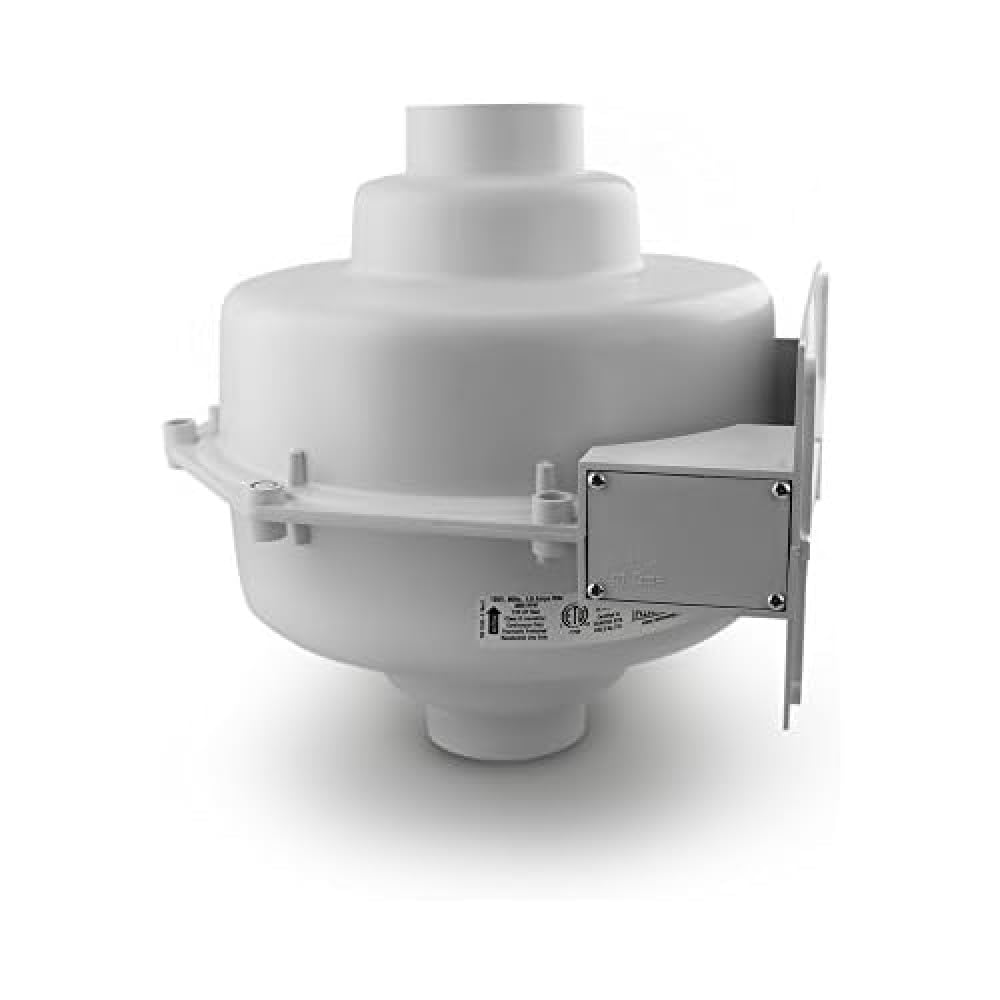
RadonAway GP501 3-Inch Radon Mitigation Fan
Designed specifically for sub-slab radon mitigation systems, this fan is a core component for safely venting dangerous gases. Its flexible installation options and sealed construction for negative pressure make it suitable for a range of residential setups. The five-year warranty provides added assurance for a critical safety device.
Pros
- Specifically engineered for radon mitigation applications
- Offers versatile mounting for duct pipe or with an integral flange
- ETL listed for safe indoor or outdoor use
- Seams are sealed to perform under negative pressure
- Backed by a five-year limited manufacturer's warranty
Cons
- Plastic construction may be less durable than metal alternatives for some users
- Designed for a specialized, single-purpose use rather than general ventilation
XYFair PF-100 4-Inch Radon Mitigation Fan
A specialized waterproof fan engineered for radon gas mitigation in home retrofits. Its IP67-rated, fully sealed design is built for reliable indoor or outdoor installation, moving air efficiently at 190 CFM with quiet operation.
Pros
- True IP67 waterproof rating for versatile indoor/outdoor use
- Fully sealed housing designed to prevent radon leakage
- Quiet operation and energy efficient at 5 watts
- Includes an 8-year limited warranty
- Easy installation with included mounting brackets
Cons
- Single-speed operation offers no airflow adjustment
- Industrial style may not suit all home aesthetics
How We Picked
To build this list of the best radon fans, we analyzed 8 models from leading brands like RadonAway, Suncourt, Tjernlund and more. Our process focused on comparing objective specifications and aggregating verified customer feedback to identify which products consistently deliver on their promises. We prioritized transparency, relying on measurable data rather than subjective claims.
- Airflow Performance (CFM): The fan’s ability to move sufficient air to create the necessary vacuum under your slab.
- Noise Level (dB): Critical for indoor or attic installations where quiet operation is desired.
- Durability & Warranty: Build quality and manufacturer support for a component meant to run continuously for years.
- Installation Compatibility: Fit with standard 4-inch or 4.5-inch PVC ducting and ease of wiring.
- Indoor/Outdoor Suitability: Weatherproofing and housing integrity for the intended installation location.
Buying Guide: Making Sense of Best Radon Fans For Basements
Match CFM to Your Home’s Needs
Cubic Feet per Minute (CFM) measures a fan’s airflow power. A higher CFM rating generally means the fan can create stronger suction, which is necessary for larger homes, homes with certain soil conditions, or systems with longer pipe runs. However, more power isn’t always better; an oversized fan can be noisier and less energy-efficient. For most standard residential applications, a fan in the 140-260 CFM range is typical. The RadonAway RP145C Radon Fan P/N 23030-1, for example, offers 145 CFM, which is ample for many homes while maintaining ultra-quiet operation.
Prioritize Quiet Operation
Since radon fans run 24/7, noise is a major livability factor, especially if installed in an attic above living spaces or indoors. Decibel (dB) ratings are your guide; look for models specifically advertised as “ultra-quiet” or with dB ratings below 60. Motors with permanently lubricated ball bearings, like those in the Tjernlund PVC4 Radon Mitigation Fan Model, are designed for quieter, long-term performance. For more on quiet home ventilation solutions, check out our review of the best attic fans.
Ensure Proper Fit and Installation
Compatibility with your existing PVC ductwork is non-negotiable. Most residential systems use 4-inch schedule 40 PVC pipe, but 4.5-inch fittings are also common. Verify the fan’s inlet and outlet diameters match your pipes. Some products, like installation kits, include rubber couplers that adapt between sizes and reduce vibration noise. Also, consider whether the fan is designed for indoor, outdoor, or wet location use—this affects housing material and sealing.
Quick Checklist
- CFM rating matches your home’s size and system design.
- Noise level (dB) is acceptable for the planned installation location.
- Inlet/Outlet diameter (4″ or 4.5″) fits your PVC piping.
- Housing is rated for indoor, outdoor, or wet location as needed.
- Warranty period offers adequate long-term protection.
Related reading: For comprehensive home air quality management, see our guide on the best hepa air purifiers.
FAQs
What is the best radon fans for basements in 2026?
The “best” depends on your specific needs. For a powerful, quiet, and energy-efficient option suitable for many homes, the Festa AMG Maverick Radon Fan is a top contender this 2026. It balances strong airflow with user-friendly features.
How do I know what size radon fan I need?
A qualified radon mitigation professional should perform diagnostic testing to determine the correct fan size for your specific soil conditions and home layout. They measure the suction needed (static pressure) to select a fan with an appropriate CFM rating. Using an improperly sized fan can reduce system effectiveness.
Can I install a radon fan myself?
While some kits are designed for DIY installation, involving simple wiring and coupling, radon mitigation is a serious health and safety matter. We strongly recommend consulting with or hiring a certified professional. They ensure the system is designed correctly, installed safely (especially regarding electrical codes), and effectively reduces radon levels. Learn about other DIY home projects in our Cleaning Gear section.
How loud are radon mitigation fans?
Noise varies by model. Modern fans designed for indoor or attic use, like the RadonAway RP145C, are engineered for “ultra-quiet” operation, often comparable to a quiet refrigerator hum. Fans installed outdoors are generally less of a noise concern. Always check the product’s decibel (dB) rating.
Do radon fans use a lot of electricity?
Most residential radon fans are quite energy-efficient, typically consuming between 70 to 120 watts—similar to a standard incandescent light bulb. Energy-efficient models, like the PF-100 | Radon Mitigation Fan 4″ 190CFM, are designed to minimize ongoing operating costs while running continuously.
Where should the fan be installed?
The fan is typically installed in-line on the PVC vent pipe, either in an attic, garage, or on an exterior wall. The location must be after the pipe exits the house and before it vents above the roofline. Outdoor installations require a fan with a weatherproof, UV-resistant housing. For related heating and cooling solutions, browse our Heating & Cooling category.
Final Thoughts
Selecting the right radon fan is a critical step in safeguarding your home. Our shortlist highlights three models tailored to different priorities: the Festa AMG Maverick for those seeking a powerful yet quiet all-rounder; the RadonAway RP145C for homeowners who prioritize proven, ultra-quiet reliability; and the PF-100 for budget-conscious buyers needing effective, waterproof protection. Each serves a distinct need based on performance, noise tolerance, and installation context. Remember, while the fan is the heart of the system, proper design and installation are paramount. Once your system is installed, monitor the pressure gauge regularly to ensure it’s operating correctly, and consider periodic radon retesting to verify its effectiveness. For more information on creating a comfortable and healthy home environment, explore our guide on the best mini split heat pumps for garages.
About the author
Editor, Water Filters. Grace covers water filter pitchers, faucet filters and under-sink systems. She explains certification claims, filter lifespan and replacement costs in plain language.